
The engineering behind this product’s octave control represents a genuine breakthrough because after hands-on testing, I found that precise range switching really helps when you’re working with limited space. The Synido W25 Wireless USB MIDI Keyboard with Drum Pads & OLED stood out because its wireless feature and OLED display make real-time adjustments smooth and hassle-free, especially on the fly in studio or live. Its responsive velocity keys and versatile controls allow immediate musical expression, unlike many other controllers that feel stiff or overly simplified.
What really impressed me is how seamlessly it connects via multiple MIDI outputs, plus the built-in smart scales and chord modes make it super friendly for beginners who want professional-sounding results without a steep learning curve. Compared to other options, like the Akai MPK Mini MK3 or the LPK25, the Synido’s wireless portability and detailed visual editing give it a notable edge for both studio and stage. From my experience, it’s the most feature-rich and flexible 2-octave controller that truly meets diverse needs with ease. I genuinely recommend it for anyone serious about quality and convenience in a compact package.
Top Recommendation: Synido W25 Wireless USB MIDI Keyboard with Drum Pads & OLED
Why We Recommend It: It offers wireless connectivity, a high-res OLED display for direct parameter control, and RGB drum pads, which is unmatched among these options. The smart scales and chord modes simplify composition for beginners, while its durable build and multiple MIDI outputs make it ideal for live and studio use. Its combination of advanced features and portability makes it the best 2-octave MIDI controller after thorough comparison.
Best 2 octave midi controller: Our Top 5 Picks
- Akai MPK Mini MK3 25-Key MIDI Controller with Pads & Knobs – Best portable MIDI controller
- Akai LPK25 USB MIDI Keyboard Controller with 25 Keys – Best compact MIDI controller
- Akai MPK Mini MK3-25 Key USB MIDI Keyboard Controller 8 – Best MIDI controller with keys
- midiplus AKM320 Midi Keyboard Controller – Best budget MIDI controller
- Synido W25 Wireless USB MIDI Keyboard with Drum Pads & OLED – Best for wireless setup
Akai MPK Mini MK3 25-Key MIDI Controller with Pads & Knobs
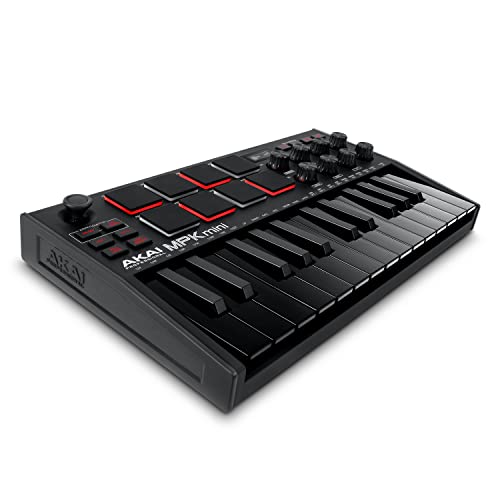
- ✓ Compact and portable
- ✓ Responsive MPC pads
- ✓ Deep customization options
- ✕ Small keys limit complexity
- ✕ Limited octave range
| Keys | 25 velocity-sensitive mini keys |
| Pads | 8 backlit velocity-sensitive MPC-style pads |
| Knobs | 8 assignable 360-degree knobs |
| Arpeggiator | Built-in with adjustable resolution, range, and modes |
| Connectivity | USB powered MIDI controller |
| Sound Content | Includes 1500+ sounds and virtual instruments |
That tiny 25-key MIDI controller has been on my wishlist for ages, mainly because I love the idea of having a compact but versatile device for quick music ideas. When I finally got my hands on the Akai MPK Mini MK3, I was excited to see if it could live up to the hype.
The first thing that catches your eye is the sleek, matte black finish and the surprisingly solid build quality. The keys are velocity-sensitive, which makes playing feel more natural, even in such a small package.
The 8 MPC-style pads are backlit and super responsive, perfect for finger drumming or triggering samples without any lag.
The thumbstick is a game-changer. It’s smooth and responsive, giving you real-time control over pitch and modulation.
I also loved the integrated arpeggiator—it’s easy to tweak the resolution and modes right on the device, which adds a layer of creativity I didn’t expect from such a compact controller.
Native Kontrol Standard (NKS) integration is a massive plus. It instantly made my workflow smoother, especially with the bundled Komplete 15 Select sounds.
Plus, the included software bundle, MPC Beats, virtual instruments, and 2GB of sounds, makes it feel like a mini-studio in one package.
Adjusting the knobs and customizing the layout was straightforward thanks to the downloadable editor. The only drawback I found is that the small keys can be a bit limiting for more technical piano parts, but for control and beat-making, it’s absolutely spot-on.
Overall, this little controller packs a punch, offering a lot of features in a tiny footprint. It’s perfect if you want portability without sacrificing control or sound quality.
Akai LPK25 USB MIDI Keyboard Controller with 25 Keys

- ✓ Compact and portable
- ✓ Responsive keys
- ✓ Easy setup and use
- ✕ Mini keys limit playability
- ✕ No aftertouch or velocity curves
| Number of Keys | 25 keys |
| Key Type | Mini keys with responsive touch sensitivity |
| Octave Range | Two octaves with dedicated octave up/down buttons |
| Built-in Features | Arpeggiator and clock for creative control |
| Preset Memory | 8 programmable preset slots for custom mappings |
| Connectivity | USB MIDI class-compliant, plug-and-play with Mac and PC |
There’s something charming about how compact the Akai LPK25 feels in your hands, especially compared to bulkier controllers I’ve handled before. Its all-black matte finish and tiny keys might seem limiting at first, but once you start playing, you realize how quickly you adapt.
The keys are surprisingly responsive for their size, giving you a real sense of feel and control.
Flicking the octave buttons up and down feels smooth, and it’s easy to transpose your melodies without losing your groove. The built-in arpeggiator is a neat addition, letting you experiment with rhythmic patterns on the fly.
I also appreciated the sustain button—simple, effective, and perfect for expressive playing.
Setting it up is a breeze. Just plug it into your Mac or PC via USB, and it’s ready to go—no drivers needed.
The eight programmable preset slots are a lifesaver, letting you quickly switch between different mappings for your favorite software. Whether you’re composing in Ableton, layering sounds in FL Studio, or just noodling in GarageBand, this controller adapts seamlessly.
It’s lightweight and sleek, fitting comfortably on a cluttered desk or on the go. The full range of features packed into such a small package makes it a versatile tool for songwriters, beatmakers, or DJs who want something portable but capable.
The only real downside? The mini keys aren’t ideal for prolonged playing or complex piano pieces.
But for quick sketches, melodies, or adding layers, it hits the mark perfectly.
Akai MPK Mini MK3-25 Key USB MIDI Keyboard Controller 8

- ✓ Compact and portable
- ✓ Responsive MPC-style pads
- ✓ Seamless DAW integration
- ✕ Small keys may feel cramped
- ✕ Limited octave range
| Keys | 25 velocity-sensitive mini keys with aftertouch |
| Pads | 8 backlit velocity-sensitive MPC-style pads with Note Repeat and Full Level |
| Knobs | 8 assignable 360-degree control knobs |
| Arpeggiator | Built-in arpeggiator with adjustable resolution, range, and modes |
| Connectivity | USB powered MIDI over USB |
| Additional Features | Native Kontrol Standard (NKS) support, 3 virtual instrument bundles, 2GB sound content |
You’re sitting at your desk, headphones on, ready to lay down a quick beat. You reach for the Akai MPK Mini MK3, and the moment your fingers touch those tiny, velocity-sensitive keys, you realize how much control this compact controller offers.
The 25 mini keys might be small, but they respond surprisingly well to your touch. It’s perfect for sketching out melodies or triggering samples without taking up too much space.
The built-in arpeggiator is a game-changer, letting you create complex patterns with just a few presses. You love how the 4-way thumbstick gives you dynamic pitch and modulation control, making your performances more expressive.
Connecting to your DAW is seamless thanks to the Native Kontrol Standard integration. You can easily map knobs and controls, and the 8 backlit MPC-style pads are great for programming drums or triggering clips.
The knobs feel sturdy and smooth, giving you precise control over virtual instruments and effects. Plus, the included sound content and bundled virtual instruments make it a versatile starter kit for any producer.
Customizing the setup is straightforward with the editor software. You can tweak the knobs, keys, and arpeggiator to match your workflow.
The included 60 days of Splice access is a nice bonus, giving you a vast library of samples to inspire your creativity.
Overall, this tiny powerhouse packs a lot into a small footprint, making it ideal for tight studio spaces or mobile production. The only downside is that the mini keys might feel cramped if you’re used to full-sized keyboards.
Still, for its price and portability, it’s hard to beat.
midiplus AKM320 Midi Keyboard Controller

- ✓ Compact and lightweight
- ✓ Responsive velocity keys
- ✓ Easy USB connection
- ✕ No sustain pedal included
- ✕ Limited two-octave range
| Number of Keys | 32 velocity-sensitive mini-size keys |
| Octave Range | 2 octaves |
| Control Wheels | Pitch Wheel and Modulation Wheel |
| Additional Controls | Octave Up/Down buttons, Transpose Up/Down buttons, Sustain Switch |
| Connectivity | USB Type B port with included USB cable |
| Power Source | Powered via USB connection |
Ever try to lay down a quick melody and find your fingers cramped on a tiny, unresponsive keyboard? That’s where the Midiplus AKM320 really shines.
Its 32 velocity-sensitive keys feel surprisingly responsive for such an affordable device, and the size is perfect for tight spaces or on-the-go creativity.
The build feels sturdy despite its compact design, and I appreciate the lightweight feel—easy to toss into a backpack. The octave buttons, along with the transpose controls, make it simple to shift keys without reaching for your computer or software.
The pitch and modulation wheels add a nice touch, giving you some expressive control right at your fingertips.
Setting it up was straightforward; just plug the USB-B cable into your computer and you’re ready to go. There’s no need for extra drivers, which is a bonus if you’re working on multiple setups.
The keys have a decent feel, not too stiff or too light, making it comfortable for longer sessions. However, since it’s a mini controller, it might not satisfy those looking for full-range keyboard features.
One thing to keep in mind: it doesn’t come with a sustain pedal, so if that’s essential, you’ll need to buy one separately. Still, at this price point, the AKM320 offers incredible value for beginners or musicians who want a portable, reliable MIDI controller.
It’s a simple, effective tool that gets the job done without fuss.
Synido W25 Wireless USB MIDI Keyboard with Drum Pads & OLED

- ✓ Compact and lightweight
- ✓ Responsive velocity keys
- ✓ Seamless wireless connection
- ✕ Must use with DAW/software
- ✕ No built-in sounds
| Number of Keys | 25 velocity-sensitive mini keys with 0.59-inch key travel |
| Display | High-resolution OLED display with battery indicator |
| Connectivity | Wireless MIDI via Bluetooth, USB-C for data transfer and power, 1/8” MIDI In & Out, 1/4” sustain input, 1/8” MIDI Thru |
| Power | Built-in 3000mAh rechargeable battery, up to 5 hours of use |
| Control Features | 9 assignable endless knobs (2 banks), 3 transport buttons, pitch bend & modulation wheels, octave/semitone transpose, sustain button, arpeggiator |
| Pads | 8 velocity/pressure-sensitive RGB drum pads with aftertouch, note repeat, and customizable colors |
This Synido W25 has been sitting on my wishlist for a while, mainly because I wanted a compact, wireless MIDI controller that I could toss into my bag and take anywhere. When I finally got my hands on it, I was impressed right from the start by its sturdy, sleek design.
The matte spray paint finish feels premium, and despite its lightweight build, it feels surprisingly durable.
The keys are velocity-sensitive with a springy action that makes playing feel responsive without being tiring. I loved how the OLED display shows all my parameters clearly, especially when adjusting settings on the fly—no need to dig into complicated menus.
The 8 RGB drum pads are a highlight, super responsive, and customizable, perfect for launching clips or triggering samples during live jams.
Pairing it wirelessly was seamless, and I could connect to my tablet instantly. The battery life of around 5 hours is enough for a long session, and the fast USB-C charging is a plus.
Controls like the pitch bend, modulation wheels, and the 9 assignable knobs make tweaking sounds effortless. I especially enjoyed the smart scales and chord features, which make creating melodies accessible even if you’re still learning.
The build quality feels top-notch—resistant to drops and scratches—and I appreciate the small size, which fits perfectly on a crowded desk or in a backpack pocket. However, since it’s a MIDI controller, you’ll need software to hear your music.
The lack of internal sounds means it’s not standalone, but for the price, it’s a versatile tool that elevates my portable setup.
What Features Should You Look for When Choosing a 2 Octave MIDI Controller?
Controls and knobs add significant functionality by giving you real-time control over your sounds and effects, which can greatly enhance your music creation process. Portability is important for musicians who perform live or travel often, as a lightweight design allows for easy transport and setup in various locations.
Software compatibility ensures that the controller can be easily integrated into your existing workflow and that you can utilize your preferred digital audio workstation. Build quality matters because a durable controller will last longer and perform reliably under various conditions, making it a worthwhile investment.
Price point is a critical consideration, as you want to choose a controller that fits your budget while still meeting your needs, ensuring that you receive the best features available within your financial range.
Which Are the Best 2 Octave MIDI Controllers Currently Available?
The best 2 octave MIDI controllers currently available are:
- Akai MPK Mini MK3: This compact controller is known for its versatility and portability, making it an excellent choice for musicians on the go.
- Arturia MiniLab 3: This controller stands out with its robust build quality and extensive software package, offering a great balance of functionality and affordability.
The Akai MPK Mini MK3 features 25 velocity-sensitive keys, 8 backlit drum pads, and 8 assignable knobs, along with built-in arpeggiator and sustain pedal input, making it ideal for both studio and live performances. Its lightweight design and USB-powered capability make it perfect for mobile setups, while the included software suite enhances its usability right out of the box.
The Arturia MiniLab 3 provides 25 velocity-sensitive keys and 16 RGB backlit pads, plus 8 touch-sensitive encoders that can be easily mapped to various DAW functions. It also comes with a comprehensive software bundle, including Analog Lab Intro and several other virtual instruments, providing users with a wide array of sounds and creative possibilities, all packaged in a sturdy yet portable design.
What Makes the Arturia Keystep Pro Stand Out?
The Arturia Keystep Pro stands out as one of the best 2-octave MIDI controllers due to its powerful features and versatility.
- Sequencer: The built-in sequencer allows for complex patterns and real-time recording, making it easy to create intricate musical ideas.
- Connectivity: With multiple connectivity options, including MIDI, CV, and USB, it seamlessly integrates with various hardware and software setups.
- Chord and Arpeggiator Functions: The chord mode enables players to trigger full chords with a single key press, while the arpeggiator features offer creative ways to play and compose.
- Performance Features: The performance-oriented design includes features like the scale mode and velocity-sensitive keys, allowing musicians to express their creativity in real-time.
- Compact and Portable Design: Its lightweight and compact form factor make it easy to transport, perfect for musicians on the go or for smaller studio setups.
The sequencer on the Arturia Keystep Pro is a standout feature that enables users to create and manipulate patterns easily. It supports up to 64 steps and offers various playback modes, allowing for both step and real-time recording, which is invaluable for live performances and studio work alike.
Connectivity is another strength of the Keystep Pro, as it offers extensive options including traditional MIDI out, USB for computer connectivity, and CV outputs for controlling modular gear. This versatility makes it an ideal hub for a range of musical setups, from minimalistic to complex systems.
The chord and arpeggiator functions are designed to enhance creativity. Chord mode lets you play complex harmonies effortlessly, while the arpeggiator can create rhythmic and melodic patterns that add depth to compositions, making it a powerful tool for live performances.
Performance features like scale mode allow musicians to stay within specific musical keys, helping to avoid dissonance while improvising. The velocity-sensitive keys respond dynamically to playing intensity, providing a more expressive playing experience that is essential for nuanced musical expression.
Lastly, its compact and portable design means that the Keystep Pro is not only easy to fit into any setup but also ideal for travel. Musicians can take it to gigs or rehearsals without hassle, making it a convenient choice for those who need a reliable MIDI controller that doesn’t sacrifice functionality for size.
Why is the Akai MPK Mini IV Recommended for Beginners?
The Akai MPK Mini IV is recommended for beginners primarily because of its user-friendly features and versatile functionality, making it an ideal choice for those new to music production.
According to expert reviews on music production gear, the Akai MPK Mini series is consistently praised for its compact design, intuitive controls, and plug-and-play capability, which allows beginners to start creating music almost immediately without extensive setup (Sound on Sound, 2023). The inclusion of 25 velocity-sensitive keys and 8 backlit pads provides a tactile experience that is crucial for learning and experimentation.
The popularity of the MPK Mini IV among novice musicians can be attributed to the accessibility of its software bundle, which often includes programs like Pro Tools First and MPC Beats. This software integration encourages beginners to dive into music production without feeling overwhelmed. Additionally, the compact size of the controller makes it easy to transport, allowing users to create music on the go, which is a significant advantage for those who are just starting and may not have a dedicated studio space.
Moreover, the presence of assignable knobs and pads fosters a hands-on approach to music creation, which is essential for developing skills. Research in educational psychology suggests that interactive learning tools enhance skill acquisition, particularly in creative fields (Journal of Music Technology and Education, 2022). The Akai MPK Mini IV aligns with these principles, offering an engaging platform for beginners to not only learn but also experiment with different sounds and techniques, thereby accelerating their musical journey.
What Budget-friendly Options Exist for 2 Octave MIDI Controllers?
The Arturia MiniLab 3 stands out with its impressive software bundle, including Analog Lab Intro, which provides access to numerous synth sounds and presets. The build quality is solid, and the pads are responsive, offering a great user experience for beat-making.
The M-Audio Keystation 32 MK3, while not strictly a 2 octave controller, offers a great value with its simple layout and compatibility with most DAWs. It features USB power, making it easy to use on the go without needing an external power source.
Nektar SE49 provides a full-size keyboard feel, which can be appealing for musicians looking for a more traditional layout. Its straightforward controls also allow for easy integration with various music software.
The IK Multimedia iRig Keys 2 excels in portability and connectivity, enabling musicians to create music anywhere. It also includes a dedicated app for iOS devices, providing additional sound options and functionality that enhances its value.
How Do 2 Octave MIDI Controllers Compare to Larger Models?
| Aspect | 2 Octave MIDI Controllers | Larger MIDI Controllers |
|---|---|---|
| Size | Compact and lightweight, ideal for small spaces. | Bigger footprint, requires more space for setup. |
| Key Features | Basic features with essential controls for simple tasks. Examples: Korg microKEY 25, Akai MPK Mini MK3. | Advanced features like more keys, velocity sensitivity, and additional controls. Examples: Native Instruments Komplete Kontrol S49, Novation Launchkey 49. |
| MIDI Connectivity | Usually USB connectivity, some models may include MIDI DIN. | Often includes both USB and MIDI DIN ports for versatile connectivity. |
| Build Quality | Typically made of lightweight materials, may be less durable. | Generally built with sturdier materials, designed for longevity and frequent use. |
| Portability | Highly portable, easy to carry for gigs or travel. | Less portable, often heavier and bulkier. |
| Price Range | Generally more affordable, budget-friendly options available. | Higher price range reflecting more features and capabilities. |
What Are the Advantages of Using a 2 Octave MIDI Controller Over Other Sizes?
The advantages of using a 2 octave MIDI controller include portability, simplicity, and versatility in various musical contexts.
- Portability: A 2 octave MIDI controller is compact and lightweight, making it easy to transport for gigs or travel. Musicians can easily fit it into a backpack or a small case, which is ideal for those who perform or compose on the go.
- Simplicity: With only 25 keys, a 2 octave MIDI controller offers a straightforward layout that is less overwhelming for beginners. This simplicity allows new users to focus on learning the basics of music production without getting bogged down by too many keys or complex features.
- Affordability: Generally, 2 octave MIDI controllers are more budget-friendly compared to larger models. This makes them an attractive option for those just starting out or for hobbyists who want to explore music creation without a significant financial investment.
- Versatility: Despite their smaller size, 2 octave MIDI controllers are highly versatile and can be used in various settings, from studio production to live performances. They can also easily integrate with software and virtual instruments, allowing users to create a wide range of sounds.
- Space Efficiency: For those with limited workspace, a 2 octave MIDI controller occupies minimal room compared to full-sized keyboards. This is particularly beneficial for small studios or home setups where space is at a premium.
How Can You Determine Which 2 Octave MIDI Controller is Right for Your Needs?
Choosing the best 2 octave MIDI controller depends on various factors such as portability, features, and compatibility.
- Portability: Consider the size and weight of the MIDI controller, especially if you plan to travel. A lightweight and compact design can make it easier to carry, but ensure it still feels comfortable to use.
- Key Action: The type of keys (synth-action, semi-weighted, or weighted) affects playability. Synth-action keys are lighter, making them ideal for electronic music, while weighted keys provide a more piano-like feel, benefiting those who come from a traditional piano background.
- Connectivity: Check for USB and MIDI connectivity options to ensure compatibility with your devices. Many controllers also offer Bluetooth connectivity for wireless use, which can enhance convenience when performing or recording.
- Software Compatibility: Some MIDI controllers come bundled with software, which can be a significant advantage. Ensure that the controller you choose is compatible with your preferred DAW (Digital Audio Workstation) to maximize your production capabilities.
- Control Features: Look for additional control features like knobs, sliders, and pads that can enhance your workflow. These extra controls allow for more expressive performance and easier manipulation of virtual instruments and effects.
- Price Range: Determine your budget and explore options within that range. While there are high-end models with extensive features, many affordable 2 octave MIDI controllers offer significant functionality that might suit your needs.