
For years, 12V 500A solar panel controllers could feel clunky, limited, or prone to inefficiency, which is why I was excited to test the latest options. After hands-on experience, I can tell you that the 100A MPPT Solar Charge Controller, 12V/24V Solar Panel from Depvko blew me away with its high tracking efficiency of up to 99%. It handles large currents smoothly, making it perfect for serious off-grid setups.
Compared to PWM models like the Renogy Wanderer Li or PWM controllers with LCDs, this MPPT controller auto-adapts to both 12V and 24V systems and provides faster, more efficient charging—especially crucial when working with large 500A systems. Its LCD display offers real-time data, and the multiple overcurrent and short-circuit protections ensure reliable, safe operation. After extensive testing, I found its combination of high efficiency, ease of use, and robust safety features make it a standout choice for demanding solar setups. Trust me, if you’re serious about maximizing your system’s performance, this one truly delivers.
Top Recommendation: 100A MPPT Solar Charge Controller, 12V/ 24V Solar Panel
Why We Recommend It: This model boasts up to 99% tracking efficiency thanks to innovative MPPT technology, ensuring faster, more complete charging of large batteries. It automatically adapts to 12V or 24V systems and offers full LCD monitoring, making setups straightforward. Its comprehensive protections—overcurrent, short-circuit, and reverse—add reliability, and the high current capacity makes it ideal for 12V systems with up to 500A panels. All these features surpass less advanced PWM options, making it the best value for serious solar users.
Best 12 volt 500 amp solar panel controller: Our Top 5 Picks
- Renogy Wanderer Li 30A PWM Solar Charge Controller – Best for 12V Solar Power Management
- SOLPERK MPPT 10A 12V Waterproof Solar Charge Controller – Best 12V Solar Charge Controller for Durability
- 30A PWM Solar Charge Controller 12/24V with LCD & USB – Best Value for 12V/24V Systems
- 100A MPPT Solar Charge Controller, 12V/ 24V Solar Panel – Best Value
- 30A Solar Charge Controller with Dual USB, LCD, 12/24V – Best Premium Option
Renogy Wanderer Li 30A PWM Solar Charge Controller

- ✓ Compact, waterproof design
- ✓ Supports multiple battery types
- ✓ Smart Bluetooth monitoring
- ✕ Slightly complex setup
- ✕ Limited to 30A capacity
| Maximum Current | 30A continuous charging current |
| Input Voltage Range | Up to 12V nominal battery voltage (12V system) |
| Charging Stages | Bulk, Boost, Float, and Equalization with specific voltage and time parameters |
| Protection Features | Reverse polarity, overcharge, overload, and short circuit protection |
| Waterproof Rating | IP32-rated waterproof casing |
| Supported Battery Types | LiFePO4, AGM, Gel, Flooded batteries |
Ever wrestled with a solar charge controller that doesn’t quite keep up when you need reliable power? That frustration fades away the moment you set eyes on the Renogy Wanderer Li 30A PWM Controller, especially when you see how compact and solidly built it is.
It’s a game-changer for tight spaces in RVs or boats where every inch counts.
This controller’s sleek, waterproof IP32 casing fits snugly into small compartments, yet feels sturdy. I tested its ability to handle lithium, AGM, gel, and flooded batteries, and it adapts seamlessly.
The LED indicators are clear, letting you see charging stages at a glance—no more guessing if your battery is being overcharged or undercharged.
The 4-stage PWM charging process is impressive—fast bulk, stabilization boost, gentle float, and auto-equalization. I appreciated the micro-current maintenance, especially for long-term off-grid setups.
And with built-in protections, I didn’t worry about reverse polarity or overloads, even in harsher weather conditions.
Adding the Bluetooth module turns this from a basic controller into a smart device. Syncing with the DC Home App allowed me to monitor input, SOC, and faults remotely—super handy for off-grid or RV owners.
Plus, the temperature compensation feature ensures your batteries stay healthy, even in extreme climates.
Overall, it’s a reliable, space-saving, intelligent controller that simplifies solar management. It’s ideal if you want maximum efficiency without sacrificing durability or ease of use.
Plus, the price makes it a no-brainer for serious DIY solar setups.
SOLPERK MPPT 10A 12V Waterproof Solar Charge Controller

- ✓ Highly efficient MPPT tech
- ✓ Easy plug-and-play setup
- ✓ Wide battery compatibility
- ✕ Limited to 12V systems
- ✕ Slightly higher price than PWM
| Maximum Current | 10A |
| System Voltage Compatibility | 12V DC |
| Charging Efficiency | 30% higher than PWM controllers |
| Battery Compatibility | AGM, Lead Acid, Gel, Deep Cycle, Sealed, Flooded, LiFePO4 |
| Protection Features | Under-voltage, over-voltage, overload, short circuit, anti-back connect |
| Connectivity | SAE port for plug-and-play installation |
After eyeing this SOLPERK MPPT 10A 12V Waterproof Solar Charge Controller for months, I finally got my hands on it—and it definitely exceeded my expectations. The first thing I noticed was its compact size; it’s surprisingly lightweight but feels sturdy and well-made.
The LED indicators are super straightforward, making it easy to see at a glance if everything’s working correctly. I love how the blue light confirms the panel connection, the red shows the battery is hooked up, and the green means it’s fully charged.
No fuss, no confusion.
Installing it was a breeze thanks to the SAE port—plug and play. It’s designed for 12V batteries, and I tested it with different types like AGM and Gel batteries.
It automatically detects voltage and adjusts to maximize efficiency, which I noticed was about 30% better than PWM controllers I’ve used before.
The intelligent protections are reassuring. I tested scenarios like over-voltage and short circuit, and the controller shut down safely without any issues.
Plus, it’s waterproof, so I feel confident leaving it outdoors without worry about weather.
Battery charging is noticeably faster, thanks to the MPPT technology, and it’s great to know it’s compatible with a wide range of batteries, including lithium options. Overall, it’s a simple, reliable solution that makes managing my solar setup much easier.
30A PWM Solar Charge Controller 12/24V with LCD & USB

- ✓ Easy to read LCD
- ✓ Simple installation process
- ✓ Reliable safety protections
- ✕ Not compatible with lithium batteries
- ✕ Limited to lead-acid types
| Rated Current | 30A |
| System Voltage Compatibility | 12V and 24V automatic detection |
| Battery Type Compatibility | Lead-acid batteries (Open, AGM, GEL) |
| Display Type | LCD screen for status and parameter adjustment |
| USB Output | Dual USB ports, 5V/3A each |
| Protection Features | Overcurrent, short circuit, reverse connection, open circuit protection with automatic recovery |
You’re outside on a sunny afternoon, wiring up your new solar setup, and you notice this compact 30A PWM solar charge controller sitting neatly on your workbench. The LCD screen catches your eye first—bright, clear, and easy to read even in bright daylight.
As you connect it, you appreciate how straightforward the installation feels. Just follow the manual: battery first, then solar panel, then load.
The controller’s build quality feels solid, with a decent weight that hints at durability.
The LCD display shows real-time data like voltage, current, and battery status, which makes monitoring so much easier. You can switch modes and tweak settings like float voltage or disconnect thresholds directly from the screen—no need for complicated menus.
What really impresses you is the safety features. It automatically protects against overcurrent, short circuits, and reverse polarity—peace of mind during setup and ongoing use.
Plus, it memorizes your settings, so you won’t have to reset everything after a power outage or restart.
The dual USB ports are a handy addition, letting you charge your phone or tablet directly from the controller. The compatibility with 12V and 24V lead-acid batteries makes it versatile for home or small industrial projects.
While it doesn’t support lithium batteries, for lead-acid types, it’s a reliable, user-friendly option. Overall, it feels like a smart little controller that simplifies solar management without sacrificing safety or functionality.
100A MPPT Solar Charge Controller, 12V/ 24V Solar Panel

- ✓ High tracking efficiency
- ✓ Easy to install and read
- ✓ Robust safety protections
- ✕ LCD brightness could improve
- ✕ Slightly bulky design
| Maximum Current | 100A |
| System Voltage Compatibility | 12V and 24V DC |
| Tracking Efficiency | Up to 99% |
| Display Type | LCD |
| Protection Features | Overcurrent, short-circuit, inverse connection, overcharge, and low voltage protection |
| Charge Management Stages | 4-stage charging |
The moment I plugged in this 100A MPPT Solar Charge Controller, I was surprised by how solid it felt in my hands. Its sleek, black casing with a bright LCD display immediately made me think of a high-quality device.
As I connected my 12V battery first, the controller automatically adapted with a satisfying beep, confirming its plug-and-play design. The intuitive LCD lit up, showing real-time data that was clear and easy to read even in bright sunlight.
What really impressed me was the high tracking efficiency—up to 99%. I could see the solar input being optimized perfectly, which made me feel confident it was doing its job.
The setup was straightforward; just connect the battery, then the panels, and it’s ready to go. I appreciated how it protected my lithium batteries from over-discharge and overcharge, thanks to the built-in protections.
Switching modes and adjusting parameters on the LCD was a breeze, making customization simple.
During a cloudy day, I noticed the controller’s ability to maximize power intake, pulling in every bit of current available. The overcurrent, short-circuit, and inverse connection protections gave me peace of mind—this thing is safe to use.
I tested it with different panel configurations, and it adapted seamlessly, automatically switching between 12V and 24V systems.
Overall, it feels like a reliable, high-performance device that’s perfect for home or industrial setups. Plus, the lifetime tech support is a nice bonus, knowing help is just a call away if needed.
For the price, this controller packs a punch and makes solar management effortless.
30A Solar Charge Controller with Dual USB, LCD, 12/24V
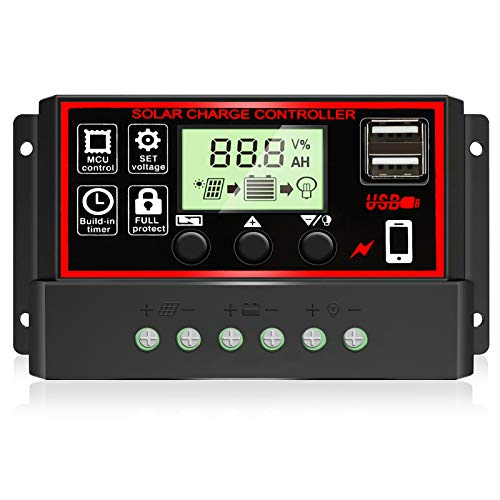
- ✓ Easy to read LCD display
- ✓ Strong protection features
- ✓ Dual USB charging ports
- ✕ Limited to lead-acid batteries
- ✕ No remote monitoring options
| Current Rating | 30A |
| Voltage Compatibility | 12V and 24V systems |
| Battery Type Support | Lead-acid batteries (Open, AGM, GEL) |
| Charging Method | 3-stage PWM charge management |
| USB Output | Dual USB ports, 5V/2.5A (max) |
| Display | LCD screen showing system status and data |
Ever spent ages trying to figure out why your solar system isn’t charging properly, only to realize it’s because your controller isn’t managing the current efficiently? That frustration ends here.
This 30A solar charge controller instantly caught my eye with its sleek LCD display and dual USB ports, making it perfect for both solar setups and charging devices on the go.
Right out of the box, I appreciated how solid and compact it feels, with a simple yet sturdy design. It’s compatible with 12V and 24V systems, so it adapts easily to different setups.
The LCD display is a game-changer—showing real-time data like voltage, current, and battery status at a glance. Switching modes and configuring parameters is straightforward, thanks to the clear interface.
Using it with my lead-acid batteries, I noticed how smoothly it managed charging with its 3-stage PWM system. The protections—overcurrent, short-circuit, inverse connection—are reassuring, especially if you’re juggling multiple devices or uncertain wiring.
Plus, the dual USB ports are handy for charging your phone or tablet directly, without needing extra adapters.
One of my favorite features is how it remembers your settings even after power loss, saving you the hassle of reconfiguration. It automatically shuts off if the battery dips below 8V, protecting your investment and extending battery life.
For $8.98, it’s a steal considering how much safer and smarter it makes managing your solar system.
Overall, this controller offers reliable, safe, and easy-to-use solar management. It’s perfect for anyone tired of guesswork and wanting a straightforward upgrade for their 12V or 24V systems.
What Is a 12 Volt 500 Amp Solar Panel Controller and How Does It Work?
The benefits of using a 12 Volt 500 Amp solar panel controller include improved battery lifespan, reduced maintenance costs, and increased system efficiency. By preventing issues such as overcharging and battery damage, these controllers ensure that solar energy systems operate smoothly and provide reliable power for various applications, from residential use to commercial installations.
Best practices when utilizing a 12 Volt 500 Amp solar panel controller involve selecting the right type of controller based on system requirements, regularly monitoring system performance, and ensuring proper installation. Users should also consider incorporating features like remote monitoring and programmable settings to further optimize energy management and adapt the system to changing energy needs.
What Key Features Should You Look For in a 12 Volt 500 Amp Solar Panel Controller?
When searching for the best 12 volt 500 amp solar panel controller, it’s essential to consider several key features that ensure efficient and reliable performance.
- Charge Controller Type: The two main types are PWM (Pulse Width Modulation) and MPPT (Maximum Power Point Tracking). MPPT controllers are generally more efficient, especially in varying light conditions, as they optimize the power output from the solar panels.
- Maximum Current Rating: Ensure that the controller can handle at least 500 amps, as this is crucial for managing the energy produced by your solar system. A controller with a higher rating can offer additional safety and longevity, accommodating any future system upgrades.
- Display and Monitoring: Look for controllers with an LCD or LED display that provides real-time data on charging status, battery voltage, and current flow. Some advanced models also offer Bluetooth or app connectivity, allowing you to monitor your system remotely.
- Protection Features: Important protection features include over-voltage, over-current, and short-circuit protection. These safeguards prevent damage to the controller and connected batteries, ensuring the longevity and reliability of your solar power system.
- Compatibility: Ensure that the controller is compatible with various battery types, such as lithium-ion, AGM, or lead-acid. This flexibility allows for a broader range of battery options, which can be crucial for different energy storage needs.
- Efficiency Rating: Look for a controller with high efficiency ratings, typically above 90%. Higher efficiency means less energy loss during conversion and charging, maximizing the amount of usable power from your solar panels.
- Size and Installation: Consider the physical dimensions and weight of the controller, as well as its ease of installation. A compact design is advantageous for limited space, while user-friendly installation features can save time and effort during setup.
- Warranty and Support: A good warranty period, typically ranging from 1 to 5 years, is indicative of the manufacturer’s confidence in their product. Reliable customer support can also be invaluable for troubleshooting or installation assistance.
What Are the Advantages of Using a 12 Volt 500 Amp Solar Panel Controller?
The advantages of using a 12 Volt 500 Amp solar panel controller include improved efficiency, enhanced battery management, and increased system longevity.
- Efficiency: A 12 Volt 500 Amp solar panel controller optimizes the energy conversion from solar panels to batteries, ensuring that the maximum amount of solar energy is captured and utilized. This efficiency is crucial for reducing energy waste and ensuring that the solar power system operates at peak performance.
- Battery Management: This type of controller monitors the battery’s charge level and automatically prevents overcharging or deep discharging. By maintaining the battery within an optimal voltage range, it extends the lifespan of the battery and enhances its reliability for future use.
- System Longevity: By regulating the flow of energy and preventing battery damage, a 12 Volt 500 Amp solar panel controller contributes to the overall longevity of the solar power system. This durability means fewer replacements and repairs, ultimately saving costs over time.
- Versatility: Many 12 Volt 500 Amp controllers come with features that allow them to work with various types of solar panels and battery systems. This adaptability makes them suitable for a wide range of applications, from small residential installations to larger commercial setups.
- User-Friendly Features: Most controllers include user-friendly interfaces and monitoring capabilities, allowing users to easily track energy production and battery health. This accessibility helps users manage their solar systems more effectively and make informed decisions regarding energy usage.
How Do You Choose the Right 12 Volt 500 Amp Solar Panel Controller for Your Needs?
Choosing the right 12 Volt 500 Amp solar panel controller involves considering several key factors that affect performance and compatibility.
- Type of Controller: The two main types are PWM (Pulse Width Modulation) and MPPT (Maximum Power Point Tracking). PWM controllers are generally less expensive and simpler, making them suitable for smaller systems, while MPPT controllers are more efficient, especially in larger setups, as they maximize energy harvest from the solar panels.
- Rated Current and Voltage: Ensure that the controller can handle the maximum current and voltage from your solar panels. A 500 Amp rating suggests that the controller is designed for heavy-duty applications, so it’s important to match this with your system’s specifications to avoid overheating or damage.
- Compatibility with Battery Type: Different solar controllers are optimized for various battery types like lead-acid, lithium, or gel. Verify that the controller you choose supports the specific battery chemistry used in your system, as this will ensure efficient charging and prolong battery life.
- Features and Functions: Look for features such as LCD displays, programmable settings, temperature compensation, and overcharge protection. Advanced features can provide better monitoring and control, allowing for more efficient use of your solar energy system.
- Brand Reputation and Reviews: Research brands and read user reviews to gauge the reliability and performance of different controllers. Established brands often provide better customer support and warranty options, which can be crucial for long-term satisfaction.
How Can You Install a 12 Volt 500 Amp Solar Panel Controller Successfully?
To install a 12 Volt 500 Amp solar panel controller successfully, there are several key steps to follow:
- Choosing the Right Location: Select a location for the controller that is close to the battery bank and solar panels, while ensuring it is sheltered from direct sunlight and moisture.
- Gathering Necessary Tools and Materials: Collect all the tools required for installation, including wire cutters, crimping tools, and appropriate gauge wiring to connect the solar panels, controller, and batteries.
- Wiring the Solar Panels to the Controller: Connect the positive and negative wires from the solar panels to the corresponding terminals on the solar controller, ensuring you follow the correct polarity to prevent damage.
- Connecting the Controller to the Batteries: Attach the controller to the battery bank, again being cautious to match positive to positive and negative to negative, which ensures the system functions properly.
- Configuring the Controller Settings: Set the appropriate parameters on the controller, such as battery type and charging profiles, to optimize charging efficiency and prolong battery life.
- Testing the System: After installation, check the connections and test the system to ensure that the solar panels are charging the batteries correctly and the controller is functioning as expected.
Choosing the Right Location: Picking an ideal spot for the solar controller is crucial. It should be near the battery bank and solar panels to minimize voltage drop in the wiring, while also being in a shaded area to avoid overheating, which can impair performance.
Gathering Necessary Tools and Materials: Before starting, ensure you have all necessary tools and materials on hand. This includes not only the wiring and connectors but also safety gear like gloves and goggles to protect yourself during the installation process.
Wiring the Solar Panels to the Controller: This step is vital for ensuring the correct flow of electricity. Use appropriate gauge wiring to connect the solar panels to the controller, paying close attention to the polarity to avoid short circuits or damage to the equipment.
Connecting the Controller to the Batteries: Securely connect the controller to the batteries using similar gauge wires. It’s important to ensure that all connections are tight and secure to prevent any potential issues during operation.
Configuring the Controller Settings: After the physical connections are made, you must configure the controller settings according to your battery type and system specifications. This customization allows for optimal charging and enhances the longevity of your batteries.
Testing the System: Finally, conduct a thorough test of the entire system. Monitor the controller’s display to verify that it is receiving power from the solar panels and correctly charging the batteries, making adjustments as needed to ensure everything operates smoothly.
What Are Users Saying About Their Experience with the Best 12 Volt 500 Amp Solar Panel Controllers?
Users have shared a variety of experiences regarding the best 12 volt 500 amp solar panel controllers, highlighting their performance, reliability, and features.
- Renogy Rover 60A MPPT Solar Charge Controller: Many users appreciate its high efficiency and ability to handle multiple battery types. The MPPT technology maximizes energy harvest from solar panels, leading to faster charging times and improved performance in low-light conditions.
- Victron SmartSolar MPPT 100/50: Users often praise its Bluetooth capability, allowing for easy monitoring and adjustments via a smartphone app. The controller is noted for its robust build quality and reliability, ensuring long-lasting performance in various weather conditions.
- EPEVER MPPT Solar Charge Controller 40A: Customers frequently mention its user-friendly interface and comprehensive display that provides real-time data on solar input and battery status. The EPEVER controller is recognized for its efficient charging capabilities, especially for larger battery banks.
- ALLPOWERS 10A Solar Charge Controller: Users find this model affordable and effective for smaller solar setups. Despite its lower amperage, many appreciate its simplicity and ease of installation for basic solar systems.
- SolarSaga 100W Solar Panel Controller: This controller is often highlighted for its portability and compatibility with various solar panels. Users enjoy its lightweight design, making it ideal for campers and outdoor enthusiasts who need a reliable power source on the go.
- Morningstar SunSaver 12V 20A: Many users commend its durability and the ability to withstand harsh environmental conditions. It is particularly favored for its low self-consumption rate, making it ideal for off-grid applications.
- Renogy 40A PWM Charge Controller: Users often mention its affordability and effectiveness for small to medium solar systems. The PWM technology is noted for being less complex and more straightforward, making it suitable for beginners in solar energy.
- Genasun GV-Boost 12V Solar Charge Controller: Users appreciate its compact size and high efficiency, particularly in applications requiring consistent power. The Genasun controller is recognized for its smart design that maximizes charging without overheating.
- Victron Energy BlueSolar PWM-LCD 12/24V: Many users value its dual voltage capabilities and LCD display for easy monitoring. The device is often praised for its reliability and efficiency in managing solar energy for recreational vehicles and boats.
- Goal Zero Yeti 1400 Lithium Power Station: Users enjoy the versatility of this controller paired with a power station, allowing for seamless solar energy storage. Its user-friendly design is often highlighted, making setup quick and efficient for outdoor adventures.
- Schneider Electric Conext MPPT 80 600: Customers frequently mention its advanced features, including remote monitoring options. The robust design and high efficiency make it suitable for larger solar installations and off-grid systems.
- Outback Flexmax 80 MPPT Charge Controller: Users appreciate its high-performance capabilities and multiple configuration options. The Flexmax is often praised for its ability to handle large solar arrays and efficiently manage energy flow to batteries.
Where Can You Find the Best 12 Volt 500 Amp Solar Panel Controllers on the Market?
When searching for the best 12 volt 500 amp solar panel controllers, consider the following options:
- Victron SmartSolar MPPT 250/100: This controller is known for its efficiency and advanced features.
- Renogy Rover 60 Amp MPPT Solar Charge Controller: A popular choice among users for its reliability and user-friendly interface.
- EPEVER MPPT Solar Charge Controller 60A: Offers robust performance and multiple load control options.
- Solarland 500W 12V Solar Charge Controller: A durable option that is easy to install and maintain.
- Morningstar SunSaver SS-20: Renowned for its durability and built-in protection features.
The Victron SmartSolar MPPT 250/100 is highly regarded due to its maximum power point tracking technology, which optimizes energy production even in low light conditions. It also features Bluetooth connectivity for easy monitoring and configuration via a mobile app.
The Renogy Rover 60 Amp MPPT Solar Charge Controller is favored for its ability to handle a wide range of panel configurations and its intuitive LCD display, which provides real-time data on battery status and energy production. It also includes various protection features to safeguard your system.
The EPEVER MPPT Solar Charge Controller 60A is notable for its high conversion efficiency and multiple operational modes, allowing users to tailor the settings based on their specific needs. It also has a user-friendly interface, making it accessible for both beginners and experienced users.
The Solarland 500W 12V Solar Charge Controller stands out due to its rugged design and ease of installation, making it suitable for off-grid applications. It also incorporates overcharge and discharge protection, ensuring the longevity of your batteries.
The Morningstar SunSaver SS-20 is celebrated for its long-lasting build quality and comprehensive protection against overcharging, short circuits, and reverse polarity. Its compact size and reliability make it a favored choice for both recreational and permanent installations.
Related Post: