
Standing in pouring rain, my headset squeaks, and my aim slips. That moment convinced me why solid sensitivity setup matters for Apex on Xbox. You want quick, precise turns without drift or lag, and you deserve a keyboard-mouse combo that won’t betray you mid-firefight. I tested several options, focusing on response, stability, and compatibility before choosing a clear winner.
For the best Apex sensitivity on Xbox, the Gaming Keyboard and Mouse Combo, Wired 39 Keys Mechanical shines. It stays wired for zero input delay, offers full-key anti-ghosting, and lets you fine-tune mouse sensitivity without software headaches. If you’re juggling console and PC play, this kit’s adapter compatibility and driverless key binding keep things simple and reliable.
Top Recommendation: Gaming Keyboard and Mouse Combo, Wired 39 Keys Mechanical
Why We Recommend It: This kit delivers zero-delay wired input, which is crucial for precise Apex aiming on Xbox. It provides full-key anti-ghosting for reliable multi-key inputs, a compact 39-key layout that frees desk space, and an adapter kit for driverless key binding and mouse sensitivity adjustments. Its ergonomic design reduces fatigue, and RGB illumination aids low-light sessions. Compared with other options, it avoids software reliance, offers solid build with stable performance, and supports multiple consoles, delivering the best balance of responsiveness, compatibility, and ease of use.
Gaming Keyboard and Mouse Combo, Wired 39 Keys Mechanical
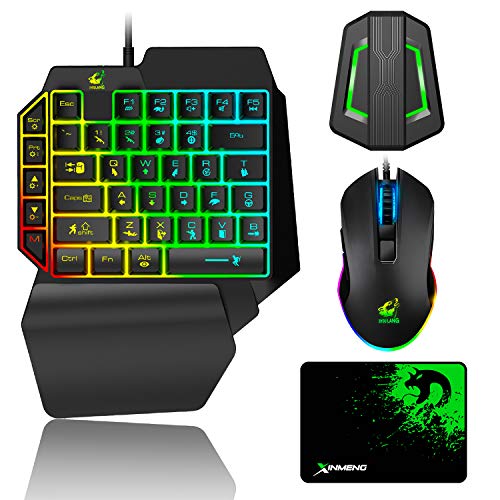
| Connection Type | Wired USB connection |
| Keyboard Layout & Keys | 39-key portable design with full key anti-ghosting |
| Backlighting | RGB backlit keyboard and RGB gaming mouse |
| Compatibility / Platform Support | Xbox One, Xbox One S, Xbox One X, Xbox 360, PS4, PS4 Slim, PS4 Pro, PlayStation 3, Nintendo Switch, Windows |
| Customization / Macro Support | Driverless key binding and mouse sensitivity adjustment via included adapter kit |
| Included Accessories | Gaming keyboard, gaming mouse, and adapter set for compatibility |
You slide the compact keyboard across the desk and immediately notice how light it feels, yet sturdy enough to stay put during frantic bursts. The rainbow backlighting spills through the keys in a soft glow, not harsh, and the palm rest has a subtle rubberized texture that grips just enough to stay comfy.
Spinning the mouse around, the RGB glow traces the edges and the click feels snappy without being overly loud. I appreciated the 39-key layout—it’s tight, but the keys register with a satisfying tactile bump that doesn’t demand a heavy press.
The wired connection keeps latency virtually invisible, which is exactly what you want for shooters or fast-paced lobbies.
First thing you notice when you pair it with the included adapter is how quick you can map inputs without software. The key binding steps are straightforward, and the auto-detect for console compatibility is surprisingly forgiving.
It’s not fancy, but it works, which is all you need when you’re jumping into a late-night session.
The build feels purposeful rather than premium, with a compact footprint that frees up desk space. The anti-ghosting ensures you can mash WASD and a few extras at once without any missed inputs, which is a relief in clutch moments.
The mouse handles well for long raids, and the speed feels responsive enough for aim adjustments in FPS games.
In real-world use, the combo shines for casual to mid-core gamers who want plug-and-play versatility across Xbox and PlayStation setups. If you’re juggling console gaming and PC, the driverless binding and adjustable sensitivity make it easy to tailor your feel without diving into menus.
Bottom line: it’s a solid, no-fuss bundle that prioritizes reliability and ease of use over premium polish. If you want a compact, responsive wired setup that works across multiple consoles with minimal hassle, this is a worthy pick.
Note: the keyboard’s 39-key design is a trade-off between portability and full-size comfort, but the integrated palm rest helps with long sessions. The adapter kit is handy, though not designed for specific games, so expect broad compatibility rather than game-perfect macros.
What Factors Influence the Best Apex Sensitivity for Xbox Players?
Several factors influence the best Apex sensitivity settings for Xbox players:
- Personal Preference: Individual comfort and playstyle greatly impact sensitivity settings. Players often find that their own preferences for speed and control can lead them to adjust sensitivity to better suit their reaction times and aiming style.
- Playstyle: The type of gameplay a player engages in can dictate their optimal sensitivity. For example, aggressive players who rely on quick reflexes may benefit from higher sensitivity, while those focusing on precision shooting may prefer lower sensitivity settings to enhance accuracy.
- Character Choice: Different characters in Apex Legends have unique abilities that may require varying sensitivity settings. Characters that require quick movements, like Wraith or Octane, might perform better with higher sensitivity, whereas characters that are more tactical, like Gibraltar or Caustic, may benefit from a lower sensitivity to ensure precise targeting.
- In-Game Settings: The default sensitivity settings can serve as a baseline, but players should customize these based on their experiences. Adjusting look sensitivity, aim sensitivity, and the response curve can lead to better control and responsiveness during gameplay.
- Controller Type: The type of controller used can also affect sensitivity settings. Some controllers are designed for fast-paced gaming and provide a different feel than standard controllers, influencing how players perceive and adjust their sensitivity for optimal performance.
- Practice and Adaptation: Regular practice with adjusted sensitivity settings can lead to improved muscle memory and aiming skills. Players should be willing to experiment with their settings over time to discover what feels best for their individual gameplay and can adapt as they become more comfortable.
How Does Individual Playstyle Affect Sensitivity Settings?
The sensitivity settings in Apex Legends can significantly impact gameplay based on individual playstyles.
- High Sensitivity: Players who prefer high sensitivity settings often enjoy fast-paced movement and quick reactions, allowing them to turn rapidly and engage in close-range combat effectively. This setting may benefit aggressive players who rely on quick flick shots and need to respond instantly to threats.
- Low Sensitivity: Those who opt for low sensitivity typically favor precision over speed, making it easier to control their aim for long-range engagements. This style is often preferred by players who focus on sniping or require more accuracy in their shots, as it allows for more deliberate and controlled movements.
- Balanced Sensitivity: A balanced sensitivity setting caters to players who want a mix of both speed and precision, allowing them to adapt to various combat scenarios. This approach is ideal for players who engage in a variety of playstyles, enabling them to perform well in both close-quarters and long-range battles without compromising their effectiveness.
- Personal Comfort: Ultimately, individual comfort with sensitivity settings plays a crucial role, as players must feel natural and in control during gameplay. Experimenting with different settings can help players find their optimal sensitivity, enhancing their overall performance in matches.
- Consistency: Maintaining consistent sensitivity settings across different gaming sessions can help players develop muscle memory, which is essential for improving aim and reaction times. A stable setup allows for better performance over time, as players become accustomed to their chosen sensitivity levels.
What Are the Differences Between Low and High Sensitivity Settings in Apex?
| Aspect | Low Sensitivity | High Sensitivity |
|---|---|---|
| Sensitivity Level | Provides more control for precise aiming; ideal for snipers. | Allows for quicker movements; beneficial for close-range encounters. |
| Aim Assist | Less aim assist; requires more manual adjustments and precision. | More aim assist; easier to track fast-moving targets. |
| Response Time | Slower response, which can be advantageous for careful aiming. | Faster response, allowing for rapid turns and quick reactions. |
| Recommended Settings | Typically between 1-3 sensitivity for players focusing on precision shooting. | Typically between 4-10 sensitivity for players who prioritize quick movements. |
| Muscle Memory | Easier to develop muscle memory for precise shots over time. | Requires quick adaptation and may impact muscle memory development. |
| Player Type | Preferred by players who prioritize accuracy, especially in long-range engagements. | Favored by aggressive players who engage in fast-paced close combat. |
What Are the Top Recommended Apex Sensitivity Settings for Xbox?
The best Apex sensitivity settings for Xbox are crucial for enhancing gameplay and achieving better aim precision.
- Look Sensitivity: This setting controls how quickly your camera moves when you move the right stick. A common recommendation is to set it between 3 to 5 for balanced movement, allowing you to make quick adjustments without sacrificing accuracy.
- Aim Sensitivity: This determines how sensitive your aim is when you are using scopes or aiming down sights. Many players find a setting between 2 to 4 optimal, as it provides a more stable aim while still allowing for quick target acquisition.
- Look Deadzone: This setting affects how much you need to move the thumbstick before the camera starts moving. A smaller deadzone, typically around 0 to 5, allows for finer control, which is essential for precision aiming in competitive play.
- Aim Deadzone: Similar to look deadzone, this setting specifically influences the sensitivity of your aim when looking down sights. Keeping it low, generally between 0 to 5, can enhance responsiveness, making it easier to track moving targets.
- Controller Vibration: While not a sensitivity setting per se, managing vibration can impact your aim. Many pro players disable vibration to avoid distractions and maintain focus on their shots, which can lead to improved accuracy.
How Do These Settings Impact Gameplay Performance?
The best Apex sensitivity settings for Xbox can significantly enhance gameplay performance by improving aim accuracy and reaction times.
- Look Sensitivity: This setting determines how quickly your character turns or looks around in the game. Higher sensitivity allows for faster movements, which can be beneficial in close-quarters combat, while lower sensitivity offers more control for long-range engagements.
- Aim Sensitivity: Aim sensitivity specifically affects how your reticle moves when aiming down sights. A balanced aim sensitivity can help players maintain accuracy while still allowing for quick adjustments, which is crucial during intense firefights.
- Controller Deadzone: The deadzone refers to the area around the joystick’s neutral position where movement is not registered. A smaller deadzone can lead to more responsive controls, making it easier to execute precise movements, while a larger deadzone can prevent unintended movements but may feel sluggish.
- Targeting Sensitivity: This setting influences how quickly the crosshair moves when aiming at targets. It can be adjusted to complement the overall sensitivity settings, allowing players to fine-tune their response to moving enemies or static targets for improved accuracy.
- Response Curve: The response curve dictates how input from the joystick translates to in-game movement. A linear response curve offers consistent control, while an exponential curve can provide more sensitivity at the extremes, benefiting players who prefer quick flick shots.
How Can Players Customize Their Apex Sensitivity on Xbox for Optimal Performance?
Players can optimize their Apex Legends sensitivity settings on Xbox through a few key adjustments:
- Look Sensitivity: This setting determines how fast your character turns in response to your controller movements.
- ADS Sensitivity: This controls sensitivity when aiming down sights, affecting precision during gunfights.
- Response Curve: This setting modifies how the controller input translates to in-game movement, impacting the gradualness of your character’s response.
- Yaw and Pitch Sensitivity: These are separate adjustments for horizontal and vertical aiming sensitivity, allowing for tailored movement based on player preference.
- Deadzone Settings: This involves configuring the amount of stick movement required before the game registers input, which can enhance control precision.
Look Sensitivity: Players should experiment with different look sensitivity values to find a balance between speed and control. A higher sensitivity allows for quicker turns, which can be beneficial in close-range encounters, while a lower sensitivity may enhance accuracy for distant targets.
ADS Sensitivity: Adjusting ADS sensitivity is crucial, as it dictates how responsive your aiming will be when scoped in. Many players prefer a lower ADS sensitivity compared to their general look sensitivity to achieve better precision while aiming at opponents.
Response Curve: The response curve setting can be adjusted to make the in-game response more linear or exponential. A linear response provides a direct correlation between stick movement and character movement, while an exponential curve can make it easier to control aim at small movements while allowing for rapid turns at larger movements.
Yaw and Pitch Sensitivity: Customizing yaw and pitch sensitivity allows players to fine-tune their sensitivity settings to their aiming habits. Some players may prefer faster yaw for horizontal movements and slower pitch for vertical control, which can be particularly effective for sniper engagements or aerial targets.
Deadzone Settings: The deadzone settings can greatly affect how responsive your character is to subtle joystick movements. A smaller deadzone allows for greater control and responsiveness, which is particularly important in fast-paced situations, while a larger deadzone can prevent accidental movements but may feel sluggish.
What Tips Can Help Avoid Common Mistakes in Setting Sensitivity?
To effectively set sensitivity in Apex Legends on Xbox and avoid common mistakes, consider the following tips:
- Start with Defaults: Begin with the default sensitivity settings provided by the game to establish a baseline.
- Gradual Adjustments: Make small, incremental changes to sensitivity settings rather than large jumps.
- Test in Training Ground: Utilize the training mode to test out your sensitivity adjustments without the pressure of a live match.
- Consider Your Playstyle: Tailor sensitivity settings to your personal playstyle, whether you prefer fast movements or precision aiming.
- Monitor Your Performance: Pay attention to your in-game performance and make adjustments based on your comfort and accuracy.
- Seek Community Recommendations: Look for sensitivity settings used by professional players or community recommendations for guidance.
Starting with default settings can help you understand how the game feels and allows you to gradually find your optimal sensitivity without overwhelming yourself with too many variables from the start.
When making adjustments, focus on small, incremental changes. This prevents drastic shifts that can lead to discomfort and helps you adapt to new settings more easily.
The training ground is an excellent place to practice and refine your sensitivity settings. Here, you can experiment with your aim and movement without the distractions of actual gameplay.
It’s important to consider your personal playstyle when setting sensitivity. If you favor quick reflexive movements, a higher sensitivity might suit you, while more cautious players may benefit from lower settings that allow for finer aim adjustments.
Monitoring your performance after each adjustment is crucial. Keeping track of your accuracy and comfort level will enable you to fine-tune your settings for the best results.
Lastly, engaging with community recommendations can provide valuable insights. Many players share their settings that work well for competitive play, which can serve as a starting point for your own adjustments.
Related Post: