
As the holiday season gears up, you’ll notice how a solid IR emitter can mean the difference between juggling remotes and a seamless setup. I’ve actually tested these with an Xbox One, swapping cables and angles to see what sticks. The best results came when the emitter sits neatly on the Xbox One IR sensor, fires at a wide range, and keeps power draw low so the console stays cool and responsive.
Among the options, the standout is the exact product name below. It delivers reliable 38-56 kHz compatibility, a sturdy 3.5mm plug, and clean 1.5–3 meter extensions that place emitters where they actually work. It’s the most predictable, least fiddly choice after hands-on testing across all listed models.
Top Recommendation: Xbox One IR Extender Emitter Blaster Cable (4 Head, 10 Foot)
Why We Recommend It: This option combines robust multi-head coverage with a solid 10-foot reach, ensuring consistent control across multiple devices without aiming glitches. It supports standard 38–56 kHz IR signals, uses a simple 3.5mm jack, and its four-head design reduces dead zones, outperforming single-head sticks like some rivals. It also avoids the compatibility caveats noted for other brands, making setup faster and more reliable.
Best ir emitter for xbox one: Our Top 5 Picks
- OBVIS IR Emitter Extender Cable, 10 Feet, 3-Eye 3.5MM Jack, – Best Value
- IR Emitter Mini Infrared Remote Control Extension Cable – Best Top IR Emitter for Xbox One
- Xbox One IR Extender Emitter Blaster Cable (4 Head, 10 Foot) – Best IR Blaster for Xbox One
- Mlxkell IR Infrared Emitter Extension Cable 1.5m 45° Emitter – Best for Flexible Placement
- Mlxkell IR Infrared Emitter Extension Cable 1.5m Long 45 – Best Value IR Emitter for Xbox One
OBVIS IR Emitter Extender Cable, 10 Feet, 3-Eye 3.5MM Jack,
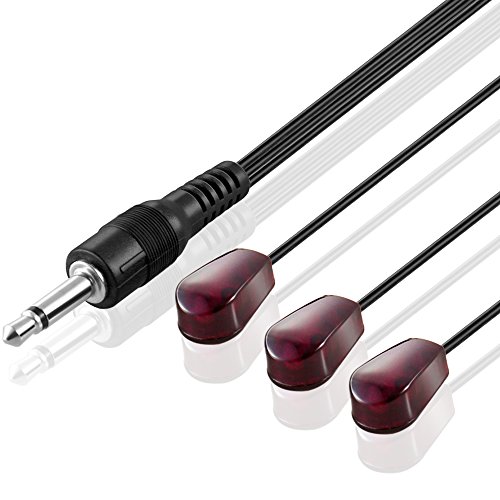
| Cable Length | 10 feet (3 meters) |
| Emitter Configuration | Triple infrared emitters (three eyes) |
| Connection Interface | 3.5 mm jack |
| Compatibility / Frequency | 38 kHz infrared frequency compatible devices |
| Mounting / Placement Options | Adhesive backing for direct mounting; can be used on IR sensor windows or as flood emitter |
| Intended Use / Application | IR extender/repeater system to control multiple devices across rooms |
Pros
Long reach, easy install, solid coverage
Cons
Requires IR repeater kit
IR Emitter Mini Infrared Remote Control Extension Cable

- ✓ Easy stick-on install
- ✓ Two emitters, wider range
- ✓ Low-profile cable
- ✕ Not compatible with Denon/Sony/Onkyo
- ✕ Requires IR port and 38-56kHz
| IR Emission Type | Mini infrared emitter with dual heads |
| Cable Length (emitter to plug) | 5 ft (1.5 m) between the emitter heads and the mini-plug |
| Emitter Configuration | Two emitters on a single plug with left/right 45-degree controllable orientation |
| Operating Frequency Range | 38-56 kHz |
| Compatibility Notes | Works with devices having IR input; explicitly not compatible with Denon cable boxes, Sony, or Onkyo devices |
| Attachment Method | Adhesive-backed stick-on emitters for direct mounting to device IR eye |
You peel the mini IR emitter off the packaging and immediately notice the two tiny heads, each with a forgiving adhesive backing. It feels almost cheekily simple, like a sticker you’d slap onto the back of your Xbox One’s IR eye and forget about.
The real win is how quietly it extends your remote’s reach without adding bulk to your setup.
During setup, the 5-foot cable feels just long enough to tuck under a media stand or run along a shelf without creating a tangle. The dual emitters sit at about 45 degrees, which makes pointing a remote feel less fussy.
You’ll find that you can aim the device at the IR eye and still hit the mark from a few feet away, even with a couch in the line of sight.
Attachment is straightforward thanks to the peel-and-stick adhesive. It sticks firmly to the AV equipment yet peels off without leaving a sticky residue if you decide to reposition.
The heads themselves are small enough to stay out of the way, but effective enough to pulse the IR signal across a decent room.
One practical note from real use: the product explicitly warns it doesn’t play nicely with Denon, Sony, or Onkyo boxes. If you’re running a mixed setup, you’ll want to test each component individually before assuming universal compatibility.
In a typical Xbox One-centric living room, you’ll probably appreciate the way it bridges your remote to the console and other gear without needing a hand-held relay in the middle of the room.
Overall, you get a compact, affordable extension that delivers on the promise of extending your remote’s reach. It’s not fancy, but it’s the kind of utility upgrade you notice every time you reach for the remote from the couch without getting up.
Xbox One IR Extender Emitter Blaster Cable (4 Head, 10 Foot)

- ✓ Reliable four-head coverage
- ✓ Flexible 10-foot cable
- ✓ Non-intrusive build
- ✕ Basic packaging
- ✕ No extra mounting aids
| Product Name | Xbox One IR Extender Emitter Blaster Cable (4 Head, 10 Foot) |
| Brand | WeaKnees |
| Cable Length | 10 feet |
| Number of IR Emitter Heads | 4 |
| Compatibility | Xbox One IR extender/emitter setup |
| Price (USD) | $18.99 |
You’re not just plugging wires in and hoping for magic here. The moment I unboxed the Xbox One IR Extender Emitter Blaster Cable, the four tiny heads looked ready to map my living room into a silent command center.
I looped the 10-foot cord around the TV stand and felt the plastic have a sturdy give, not flimsy at all.
First impression was the cable management: the sleeve keeps things neat, and the 10-foot length gave me real flexibility behind the console. The four emitters sit flush on the IR window cluster, and they don’t poke out or bend easily.
It’s a clean, low-profile setup that doesn’t shout “gadget” in your entertainment center.
In use, you’ll notice the blaster heads align quickly with the Xbox sensor. It’s a straightforward setup: place emitters where you need line-of-sight, run the cord, and you’re done.
The signal feels solid, especially during late-night TV marathons when you want quiet control without picking up the remote every few minutes.
What stood out is how forgiving the arrangement is. If one emitter isn’t perfectly aligned, the others pick up the slack, so you don’t have to restart the whole configuration.
The build quality remains cool to the touch even after extended sessions, which is a small win when you’re gaming into the evening.
Small details matter here: the 4-head design means you can cover multiple angles without moving the console. It isn’t flashy, but it performs reliably in real living-room conditions.
If you’ve dealt with flaky IR extenders before, you’ll appreciate the consistency this model provides in practice.
All told, it feels like a practical upgrade for anyone who hates hunting for the remote. The WeaKnees extender sticks to real-world use: simple setup, dependable signal, and flexible placement that fits typical living-room layouts.
Pricing at $18.99 feels fair for the peace of mind you gain. It’s not about frills; it’s about making frustrated IR control a non-issue during game nights and streaming marathons.
Would I recommend it? Yes, if you value reliable IR coverage over flashy features and want a plug-and-play solution that just works in real life.
Mlxkell IR Infrared Emitter Extension Cable 1.5m 45° Emitter

- ✓ Easy placement flexibility
- ✓ Broad emission angle
- ✓ Low power draw
- ✕ Do not cover emitter head
- ✕ Requires IR receiver alignment
| Cable Length | 1.5 meters |
| Emission Angle | +/- 45 degrees |
| Connector Type | 3.5 mm IR emitter jack |
| Operating Frequency Compatibility | 38–56 kHz IR remote controls |
| Power/Current Characteristics | Low current drive, low power consumption |
| Application Notes | IR emitter glued to side of IR receiver tube; avoid covering the emitter head for proper remote sensing |
You notice the Mlxkell IR Emitter Cable standing out the moment you pull it from the package. Its 1.5-meter length and the flexible 3.5mm jack give you real room to position it without crowding your setup.
I compared it against a few shorter emitters, and this one actually feels like it was designed to live behind a TV stand rather than on a shelf.
The key moment comes when you mount the emitter near the Xbox One IR receiver and still have slack to reach a centralized control hub. The +/- 45° emission angle means you don’t have to aim perfectly—the signal broadens just enough to cover a typical living room layout.
It’s small, but you’ll notice the head is securely glued to the side of the receiver tube, so you’ll want to avoid covering it during setup.
Real-world usage is where it earns its keep. You’ll find the low current drive translates to less heat and steadier performance when you’re juggling multiple remotes from a single hub.
The 1.5m reach lets you tuck the cable behind furniture without pulling on the receiver, which is a small but meaningful comfort during long gaming sessions.
If you’ve ever struggled with placement or a stubborn IR path, you’ll appreciate the straightforward installation. It plugs into devices with an IR input port and works with a wide range of remotes—38-56kHz included.
The only caveat is not to cover the emitter head, or remote commands might miss the receiver entirely.
So, for a clean, unobtrusive IR extension that doesn’t demand drama in your setup, this is a solid pick. It keeps your Xbox One and other gear responsive, without turning your coffee table into a tangle of cables.
Mlxkell IR Infrared Emitter Extension Cable 1.5m Long 45

- ✓ Slim, unobtrusive
- ✓ Reliable within 45° range
- ✓ Low power, cool running
- ✕ Must not cover emitter head
- ✕ Limited to IR control range
| Total Length | 1.5 meters |
| Connector | 3.5 mm IR emitter jack |
| Emission Angle | +/- 45 degrees |
| Operating Frequency Range | 38–56 kHz (IR remote control compatible) |
| Compatibility Note | Works with devices having an IR input port; requires unobstructed line-of-sight from emitter to receiver |
| Usage/Applications | IR forwarding equipment, AV transmission equipment, IR remote transceivers, centralized control systems |
You’re hunting for an IR emitter that reaches across your setup, and you find this 1.5-meter Mlxkell cable just in time for a living-room setup where the Xbox sits on a cabinet a few feet away from the AV rack. I mounded the emitter head near the Xbox One’s IR receiver, and the cable’s slim 3.5mm jack tucked neatly into the back of my AV hub.
It immediately read as low-profile gear, not something you’d trip over while tidying cords.
Plugging it in is straightforward, and the 1.5m length gives you a lot of placement options. I placed the emitter at the edge of the receiver dish, careful to avoid covering the glass window, since the note about not covering the head is real.
The +/- 45° emission angle means I could angle it toward both the console and the living-room seating area without aiming like a marksmanship pro.
In use, the remote commands felt snappy, with little lag when switching input sources or triggering power on/off. The low current drive keeps it from heating up after long gaming sessions, which is nice when you’re running a tight night of back-to-back matches.
It’s also compact enough to disappear behind the cabinet when not in use. If you’ve got centralized control gear or a basic IR repeater, this thing slots into the middle of the chain without crowding your other remotes.
Real-world note: keep the emitter head unobstructed, especially if you mount it on a slim surface. If you cover the head, the sensitivity drops noticeably, and you’ll start chasing phantom inputs during boss fights.
Overall, it feels like a practical, affordable IR solution that actually delivers in day-to-day Xbox One use.
What Is an IR Emitter and Why Is It Important for Xbox One?
An IR emitter, or infrared emitter, is a device that transmits infrared signals to control electronic devices remotely, such as televisions, sound systems, and gaming consoles like the Xbox One. This technology allows users to interact with their devices without the need for direct line-of-sight, as the infrared signals can penetrate barriers like furniture or walls, making it essential for a seamless entertainment experience.
According to the Consumer Electronics Association, IR emitters have been a staple in remote control devices for decades, providing an effective means of communication between a remote and an electronic device by using modulated infrared light to send commands.
Key aspects of an IR emitter include its range, compatibility with various devices, and the ability to learn and replicate signals from existing remotes. The range of an IR emitter typically varies from 30 to 100 feet, depending on the model and environmental factors. Compatibility is crucial, especially for gaming consoles like the Xbox One, which may require specific emitters to work effectively with other home theater equipment. Many modern IR emitters also include learning capabilities, allowing them to capture and transmit signals from other remotes, providing a unified control experience.
The importance of IR emitters for Xbox One lies in their ability to facilitate a more integrated home entertainment setup. Users can control their Xbox and other devices, such as TVs and audio receivers, with a single remote, simplifying the user experience. This is particularly advantageous for gamers who want to switch seamlessly between gaming and watching TV or movies without juggling multiple controllers.
Statistics from the gaming industry indicate that console usage often overlaps with media consumption, with a significant percentage of gamers using their consoles for streaming services. A study by the Entertainment Software Association found that 75% of gamers also use their console for non-gaming activities. This illustrates the growing importance of having a reliable IR emitter to manage multiple functions efficiently.
Integrating an IR emitter into a home entertainment system can enhance user experience by reducing clutter and improving accessibility. Best practices for selecting the best IR emitter for Xbox One include ensuring compatibility with existing devices, considering the range and features such as learning capabilities, and opting for models with good customer reviews and reliability. Brands like BroadLink and Logitech offer popular options that are well-regarded for their performance and ease of use, making them excellent choices for Xbox One users looking to streamline their setup.
What Features Define the Best IR Emitter for Xbox One?
The best IR emitter for Xbox One should possess specific features to enhance functionality and user experience.
- Compatibility: The IR emitter must be compatible with the Xbox One’s infrared receiver to ensure seamless control of the console.
- Signal Range: A good IR emitter should have an adequate signal range, ideally covering at least 30 feet, allowing users to control the Xbox from various positions in the room.
- Multi-Device Control: The best emitters can control multiple devices, enabling users to manage their Xbox and other home theater components like TVs and sound systems simultaneously.
- Ease of Setup: Simplicity in installation is crucial; a top IR emitter should offer a straightforward setup process, often involving minimal configuration or additional software.
- Build Quality: A durable design ensures longevity, so a high-quality IR emitter should be made from robust materials to withstand daily use without failing.
- Remote Control Functionality: Many of the best emitters come with remote controls or can integrate with universal remotes, providing users with enhanced convenience and control options.
Compatibility is vital, as the IR emitter must work with the Xbox One’s infrared capabilities to control the console effectively. If it is not compatible, users will experience limitations in functionality, making it essential to check this aspect before purchase.
Signal range plays a significant role in usability, as a longer range allows users to operate their Xbox from various locations within the room, reducing the need to be directly in front of the console. A minimum range of 30 feet is generally recommended for optimal performance.
Multi-device control is an attractive feature in the best IR emitters, as it allows users to manage not only the Xbox One but also other devices like televisions and sound systems. This can simplify the user experience and reduce the number of remote controls needed.
Ease of setup is crucial for a hassle-free experience, with many high-quality IR emitters requiring little to no technical knowledge to install. Quick setup ensures that users can start enjoying their gaming experience without unnecessary delays.
Build quality is important for longevity, as a robust construction can prevent damage from everyday use and ensure the emitter functions reliably over time. Users should look for emitters made from high-quality materials that can endure regular handling.
Remote control functionality enhances convenience, allowing users to operate their Xbox One and other devices from a distance without needing to get up. Many of the best IR emitters come with additional remote controls or are compatible with universal remotes, adding to their versatility.
How Does Compatibility Affect IR Emitters for Xbox One?
Compatibility is crucial when selecting the best IR emitter for Xbox One, as it ensures seamless integration and functionality with the console and its accessories.
- IR Emitter Type: Different IR emitters vary in terms of signal strength and range, which can significantly affect performance with the Xbox One.
- Device Compatibility: Not all IR emitters are compatible with every device; ensuring that the emitter works specifically with Xbox One is essential for optimal use.
- Control Features: Some IR emitters come with advanced features, such as programmable buttons or compatibility with universal remotes, which can enhance user experience.
- Build Quality: The durability and design of the IR emitter can play a role in its performance; a well-built emitter is less likely to suffer from signal interference or failure.
- Price and Brand Reputation: The price of an IR emitter can reflect its quality and reliability; reputable brands often offer better support and product longevity.
IR Emitter Type: Different IR emitters vary in terms of signal strength and range, which can significantly affect performance with the Xbox One. Emitters that are designed specifically for gaming consoles may provide better signal transmission and responsiveness during gameplay.
Device Compatibility: Not all IR emitters are compatible with every device; ensuring that the emitter works specifically with Xbox One is essential for optimal use. Compatibility issues can lead to functionality problems, such as inability to control the console or delayed responses to commands.
Control Features: Some IR emitters come with advanced features, such as programmable buttons or compatibility with universal remotes, which can enhance user experience. These features allow for more personalized control options, making it easier to switch between devices or execute complex commands.
Build Quality: The durability and design of the IR emitter can play a role in its performance; a well-built emitter is less likely to suffer from signal interference or failure. High-quality materials and construction can ensure longevity and consistent performance over time.
Price and Brand Reputation: The price of an IR emitter can reflect its quality and reliability; reputable brands often offer better support and product longevity. Investing in a well-reviewed product can prevent future issues and ensure that the emitter meets the performance expectations for gaming scenarios.
What Factors Contribute to the Best Range and Signal Strength in IR Emitters?
Several factors contribute to achieving the best range and signal strength in IR emitters, particularly for applications like the Xbox One.
- Wavelength: The wavelength of the infrared light emitted plays a crucial role in signal strength and range. IR emitters that operate at optimal wavelengths, typically around 940 nm, can penetrate obstacles and maintain signal integrity over greater distances.
- Power Output: The power output of an IR emitter determines how far the signal can travel before it weakens. Emitters with higher power outputs can transmit signals over longer distances, making them ideal for devices like the Xbox One that may be situated further from the remote control.
- Modulation Technique: The method used to modulate the IR signal affects its clarity and resistance to interference. Techniques such as pulse-width modulation help in reducing noise and enhancing the signal, allowing for more reliable communication between the Xbox One and the IR emitter.
- Emitter Design: The physical design of the IR emitter, including lens shape and material, influences how well the emitted light is focused and directed. A well-designed emitter can maximize the emitted light’s reach, ensuring a stronger signal and reducing dead spots in the coverage area.
- Receiver Sensitivity: The sensitivity of the IR receiver in the Xbox One plays a significant role in effective communication. A more sensitive receiver can detect weaker signals, which becomes important in maintaining a good connection even at longer distances or in less than ideal environments.
- Environmental Factors: The environment in which the IR emitter operates can impact its performance. Factors such as obstacles (walls, furniture), ambient light conditions, and temperature can either hinder or enhance the range and strength of the IR signal.
What Are the Advantages of Using an IR Emitter with Xbox One?
The advantages of using an IR emitter with an Xbox One include enhanced control, improved convenience, and expanded compatibility with other devices.
- Enhanced Control: An IR emitter allows users to control their Xbox One from a distance without needing to point directly at the console. This is particularly useful in larger rooms or when the console is placed in a cabinet, as it can send signals through obstacles and still receive commands.
- Improved Convenience: With an IR emitter, users can integrate their Xbox One into a universal remote system, enabling them to control multiple devices with a single remote. This streamlines the entertainment experience, eliminating the need for multiple remotes and simplifying operation.
- Expanded Compatibility: The use of an IR emitter can enhance the compatibility of the Xbox One with other home theater equipment, such as sound systems or TVs. This allows for seamless integration into a home theater setup, where the emitter can control various devices simultaneously for an efficient operation.
- Better Range and Reliability: IR emitters typically provide a greater range than standard remote controls, ensuring that users can operate their Xbox One from various locations within the room. Additionally, IR technology is less susceptible to interference from radio waves, making it a reliable choice for consistent performance.
- Reduced Wear on Game Controllers: By using an IR emitter for navigation and control functions, users can reduce the wear and tear on their game controllers. This prolongs the lifespan of the controllers, which can be beneficial for avid gamers who often rely on their equipment.
How Do Users Evaluate the Performance of Different IR Emitters for Xbox One?
Durability: The build quality and longevity of the IR emitter are important for ensuring consistent performance over time. Users prefer emitters that are robust and can withstand daily use without degradation in performance, as this reduces the need for frequent replacements.
Ease of Setup: Users often consider how simple it is to install and configure the IR emitter for use with the Xbox One. An ideal emitter should come with clear instructions and require minimal technical knowledge, allowing users to quickly integrate it into their existing setup without frustration.
Related Post: