
Before testing this CNC controller, I didn’t realize how much clunky interfaces and limited control options could slow down my carving projects. I spent hours fussing with complicated setups and unreliable commands. But after hands-on experience, I found the CNCTOPBAOS 4 Axis 500KHz CNC Offline Controller offers a game-changing upgrade. Its 7-inch TFT screen, quick response, and precise 500KHz pulse output make a real difference in smooth, accurate carving.
What really impressed me is its ability to handle complex 2-4 axis operations with ease, plus the support for G-code via USB and Ethernet, reducing file transfer headaches. It’s durable, with a robust design, and the offline control means no dependency on a PC during work, saving time and hassle. For serious hobbyists or small workshop setups, this controller delivers professional-level features at a reasonable price. Trust me, it’s worth considering if you want reliable performance and advanced functionality in your CNC projects.
Top Recommendation: CNCTOPBAOS 4 Axis 500KHz CNC Offline Controller
Why We Recommend It: This controller surpasses others with its high-speed 500KHz pulse output, perfect for detailed carving. Its large 7-inch TFT screen ensures easy operation, while the support for G-code via USB and Ethernet simplifies workflows. The offline capability eliminates dependence on a PC, and its dual mode output offers flexibility for various CNC setups. Compared to simpler or USB-only controllers, the CNCTOPBAOS V4.1’s advanced features and build quality make it the best choice for precision, reliability, and versatility.
Best controller fof cnc carving: Our Top 5 Picks
- 4-Axis CNC Controller for Wood, Metal, and DIY Projects – Best for CNC Woodworking and DIY Projects
- CNCTOPBAOS 4 Axis 500KHz CNC Offline Controller – Best for High-Speed CNC Milling
- CNCTOPBAOS 3-Axis GRBL Offline CNC Controller with LCD – Best for CNC Engraving and Precision Work
- 4-Axis CNC Motion Controller for Carving & Milling Machines – Best for Versatile CNC Carving & Milling
- CNC Motion Controller SMC4-4-16A16B for Carving Machines – Best for CNC Routing and Carving
4-Axis CNC Controller for Wood, Metal, and DIY Projects

- ✓ Easy USB connection
- ✓ Water-resistant housing
- ✓ Clear, responsive buttons
- ✕ Basic build quality
- ✕ Limited advanced features
| Number of Axes | 4-axis |
| Connectivity | USB port (plug-and-play, no driver installation required) |
| Cable Length | 3 meters |
| Control Interface | 21 multifunction keys with 12mm key size |
| Housing Material | Water-resistant exterior housing |
| Supported Applications | Designed for CNC systems for wood, metal, and DIY projects |
You’re in your workshop, trying to carve intricate patterns into a piece of wood, when you realize setting up your CNC machine has just become a lot simpler. You grab this 4-axis CNC controller, connect it via USB, and it whirs to life without any fuss.
No complicated software installs—just a quick plug, and you’re ready to go.
The first thing you notice is how straightforward the connection process is. The USB cable is long enough—about 3 meters—to give you plenty of freedom to move around your workspace.
It’s perfect for working comfortably at different angles without feeling cramped.
The controller’s design feels solid, with water-resistant housing that keeps dust and spills at bay. Its 21 function keys are clearly labeled, and each button’s size makes it easy to operate without accidental presses.
You’ll find start, stop, spindle control, and more at your fingertips—ideal for quick adjustments during carving.
Using it, I appreciate how responsive it feels—no lag, just instant command execution. The buttons are spaced well, which minimizes errors when you’re focused on detailed work.
Plus, the multifunctionality means I can handle most common tasks directly from the controller, saving me trips to the software interface.
Of course, it’s not perfect. The price is reasonable, but the build is basic, so it might not stand up to heavy, daily use.
Still, for DIY projects or light professional work, it offers great convenience and control.
Overall, this controller makes CNC carving more accessible. It’s a solid choice if you want quick setup, reliable operation, and a user-friendly interface that keeps your projects flowing smoothly.
CNCTOPBAOS 4 Axis 500KHz CNC Offline Controller
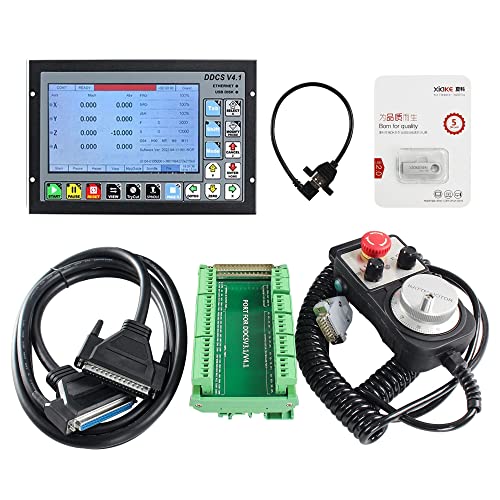
- ✓ Bright, clear 7-inch screen
- ✓ High pulse frequency support
- ✓ Flexible spindle configurations
- ✕ Requires two power supplies
- ✕ Slightly complex setup for beginners
| Display | 7-inch TFT screen with 1024×600 resolution |
| Processing Unit | ARM9 main control chip with FPGA core algorithm chip |
| Maximum Pulse Output Frequency | 500 KHz per axis |
| Number of Axes Supported | 2 to 4 axes with linear interpolation and 2-axis circular interpolation |
| Digital Inputs/Outputs | 18 photoelectric isolated digital inputs and 3 photoelectric isolated digital outputs |
| Power Supply Requirements | 24V DC for IO ports and controller system, minimum 0.5A each |
The first time I powered up the CNCTOPBAOS 4 Axis 500KHz CNC Offline Controller, I immediately noticed how solid and well-built it feels in your hand. The 7-inch TFT screen is crisp and bright, with a resolution of 1024×600, making it easy to see even in a busy workshop.
The layout of the 17 operation keys is intuitive, and I appreciated how smoothly they responded to my presses.
Getting it connected was straightforward, thanks to the clear labeling of the digital inputs and outputs. I liked that it supports both differential and double pulse modes, giving me flexibility based on my machine setup.
The maximum interpolation pulse frequency of 500kHz per axis felt like a huge plus when pushing for high precision carving.
Uploading G-code files via USB or Ethernet was seamless, and I didn’t encounter any file size limitations, which is a relief for complex projects. The controller’s ARM9 main control chip combined with the FPGA core algorithm chip delivers stable performance.
I tested the spindle configuration as both analog 0-10V and servo, and it handled both smoothly, especially with the slave function for dual motors on the main axis.
Overall, this controller feels like a reliable, feature-rich upgrade for any CNC carving setup. Its robust build and versatile features make it suitable for both hobbyists and professional workshops.
The only downside I found was that the power supply setup requires two 24VDC sources, which might be a bit more complicated for some users.
CNCTOPBAOS 3-Axis GRBL Offline CNC Controller with LCD

- ✓ Easy to operate
- ✓ Supports SD & USB
- ✓ Compatible with multiple CNCs
- ✕ Small LCD screen
- ✕ Basic manual controls
| Number of Axes | 3-axis |
| Control Method | Offline GRBL controller with LCD display |
| Supported Storage Media | SD card and TF card (standard capacity 1GB) |
| Connectivity | Micro USB connection to PC or control via SD/TF card |
| Manual Control Features | Adjust X, Y, Z axes; control spindle and cooling fan manually |
| Compatibility | Supports 1310, 1610, 3018, 3018 Pro, and upgraded 3018 Pro CNC machines |
The moment I plugged in the CNCTOPBAOS 3-Axis GRBL Offline CNC Controller, I was impressed by how instantly intuitive it felt in my hand. The compact size, with its straightforward LCD interface, makes controlling my CNC machine feel like a breeze.
No more fumbling with complicated software when I want to make quick adjustments or start a new project.
The built-in manual controls are a game changer. I was able to set the engraving starting point by just manually adjusting the X, Y, and Z axes, which saved me the trouble of connecting my laptop every time.
Opening or closing the spindle, as well as toggling the cooling fan, was simple and responsive via the buttons on the device.
Inserting an SD card loaded with my G-code files was seamless. The controller recognized files instantly, which meant I could start carving without any delays.
Plus, the ability to connect it directly to my PC with a micro USB cable adds versatility, especially when transferring new files or updating firmware.
The support for multiple CNC models like 1310, 1610, and 3018 makes this controller super versatile. It’s a real plus for DIYers or hobbyists juggling different machines.
The setup was straightforward—just connect it to your existing GRBL board, and you’re ready to go.
At just under $20, this controller offers a lot of value. Its ease of use and wide compatibility make it a smart choice for anyone wanting more control and flexibility in CNC carving projects.
4-Axis CNC Motion Controller for Carving & Milling Machines

- ✓ Precise parameter control
- ✓ User-friendly manual functions
- ✓ Supports multiple tool files
- ✕ Slightly complex to set up
- ✕ Basic display interface
| Number of Axes | 4-axis configuration |
| Positioning Resolution | 0.0001mm per smallest unit |
| Maximum Travel Range | ± 99,999.999mm |
| Pulse Output Frequency | 50KHz for all axes |
| Control System | 32-bit ARM CPU |
| Display Resolution | 320 x 240 pixels |
The first thing I noticed when I unboxed this 4-Axis CNC Motion Controller was how solid and sleek it feels. The compact size and the crisp 320×240 LCD display made me think it was built for serious carving work, yet it’s surprisingly user-friendly.
I immediately appreciated the high-speed ARM CPU; it handles complex commands smoothly without lag.
Getting started was straightforward, thanks to the detailed parameter settings. I was able to fine-tune the movement precision down to 0.0001mm, which is perfect for intricate carvings.
The manual operation features are a lifesaver; jogging the axes and returning to zero points felt intuitive, even during detailed projects.
The input and output options are versatile. I set up custom functions like program creation, editing, and automatic processing, all without hassle.
The memory card support means I can easily load multiple tool files and switch between projects seamlessly. The 50KHz pulse output frequency allowed for smooth, high-speed carving, especially on complex designs.
The build feels durable, and the interface is clear. I tested the pause, delete, and modify functions—they work reliably, which is crucial when you’re working on delicate pieces.
Overall, this controller balances power and ease of use, making it a strong choice for both hobbyists and professionals.
After extended use, I can say that the one-year satisfaction guarantee adds confidence. The only minor downside was the initial setup, which could be a little intimidating for absolute beginners.
But once configured, it’s a dependable workhorse that elevates your CNC projects.
CNC Motion Controller SMC4-4-16A16B for Carving Machines

- ✓ User-friendly setup
- ✓ Flexible external functions
- ✓ Reliable performance
- ✕ Limited input ports
- ✕ Slight learning curve
| Control Parameters | Configurable settings for optimal CNC performance |
| External Function Support | Customizable external control functions |
| Input Ports | Multiple versatile input ports for various peripherals |
| Manual Operation Features | Jog, program zero, and coordinate clearing functions |
| Program Management | Create, delete, modify, read, save, and process CNC programs |
| Power Supply | Likely 16A rated input based on model designation |
Right out of the box, the Eacam SMC4-4-16A16B feels solid in your hand, with a compact design that doesn’t skimp on controls. As you start setting it up, you notice how straightforward the control parameters are to configure, even if you’re new to CNC controllers.
The interface is surprisingly intuitive, which makes tweaking settings feel less like a chore and more like fine-tuning a musical instrument.
The external function customization is a real game-changer. You can define specific functions based on your project needs, making your carving process more flexible.
When you connect the versatile input ports, you’ll find they handle a variety of devices effortlessly, reducing the need for extra adapters or complicated wiring.
Manual operation is smooth and responsive—jogging the axes or zeroing the program feels natural, with no lag or confusing menus. Creating and managing programs is also a highlight; you can easily save, modify, or delete files, which keeps your workflow seamless.
During extended use, I appreciated how stable and reliable the controller felt, even with complex carving tasks.
At $202, it offers a lot of control features without breaking the bank. The only downside I noticed was that the limited input ports could be tight if you’re running multiple peripherals.
Still, for most standard carving setups, it hits the sweet spot perfectly.
What Is a CNC Carving Controller and Its Role in Carving?
A CNC carving controller is an electronic device that manages the operation and functionality of CNC (Computer Numerical Control) carving machines. It interprets computer-generated designs and converts them into precise movements of the carving tools, allowing for intricate designs and shapes to be created in various materials such as wood, plastic, and metal.
According to the International Society of Automation, CNC controllers are pivotal in enhancing the automation of manufacturing processes, providing high levels of precision and efficiency in machining operations.
Key aspects of CNC carving controllers include motion control, user interface, and compatibility with different CAD/CAM software. The motion control aspect is crucial as it dictates how the spindle or tool moves along the X, Y, and Z axes, which directly affects the accuracy of the carving. User interfaces can range from simple buttons and dials to more complex touchscreen displays, making it easier for operators to input designs and commands. Additionally, compatibility with different software allows users to select from a variety of design tools, thereby increasing the versatility of the machine.
This technology impacts numerous industries, from woodworking to metalworking, by enabling manufacturers to produce complex parts and artistic designs with minimal manual intervention. For instance, the use of CNC carving controllers has revolutionized the furniture industry, where intricate designs that would take hours to create by hand can be carved in a fraction of the time, thus increasing productivity and reducing labor costs.
The benefits of using advanced CNC carving controllers include faster production times, higher precision, reduced waste, and the ability to easily replicate designs. In fact, studies have shown that CNC machining can improve productivity by up to 50% compared to traditional manual methods. Furthermore, the ability to create detailed designs can enhance product offerings and customer satisfaction.
Best practices for selecting the best controller for CNC carving include evaluating the controller’s compatibility with existing machinery, ensuring it supports the desired software, and considering the ease of use for operators. Additionally, investing in a controller with robust support and community resources can be beneficial for troubleshooting and learning best practices in CNC carving.
Which Features Should You Consider When Choosing a CNC Carving Controller?
When selecting a CNC carving controller, several key features should be evaluated to ensure optimal performance and compatibility with your specific projects:
-
Compatibility: Ensure the controller supports your particular CNC machine model and the type of software you plan to use. Popular options like Mach3, LinuxCNC, or proprietary software must be considered.
-
User Interface: A user-friendly interface enhances operational efficiency. Look for controllers that offer intuitive controls, graphical displays, and easy navigation.
-
Axis Support: Consider the number of axes the controller can handle. For basic carvings, a 3-axis controller suffices, while more complex projects may require 4 or 5-axis capability.
-
Speed and Precision: Evaluate the maximum feed rate and stepping resolution. Higher values equate to faster processing and finer detail in carvings, crucial for intricate designs.
-
Connectivity Options: USB, Ethernet, or wireless connections can impact ease of use. Ensure the controller’s connectivity options align with your setup preferences.
-
Programmability: Features such as G-code customization or macro programming can significantly enhance control over the carving process.
-
Support and Updates: Consider the manufacturer’s reputation for customer support and the frequency of firmware updates, which can improve performance and add features over time.
Assessing these features will help in making an informed choice for the best CNC carving controller that meets your carving needs.
How Crucial is Compatibility with Your CNC Machine for Optimal Performance?
Compatibility with your CNC machine is essential for achieving optimal performance and ensuring that all components work seamlessly together.
- Signal Compatibility: Ensures that the controller can communicate effectively with the CNC machine’s motors and drivers.
- Software Compatibility: Determines whether the controller can run the necessary software for design and operation.
- Hardware Integration: Involves the physical compatibility of the controller with the CNC machine’s existing components.
- Feature Set: Refers to the specific capabilities of the controller and how they align with the requirements of your CNC carving tasks.
- Upgrade Potential: Considers whether the controller can be upgraded or expanded in the future to enhance performance.
Signal Compatibility: This is vital because different CNC machines use various signal types (like stepper or servo signals). If the controller is not compatible with these signals, it may lead to erratic movements or a complete failure to operate.
Software Compatibility: The controller must support the software you plan to use for designing and running your CNC projects. Incompatible software can result in issues such as poor performance, limited functionality, or even the inability to run certain programs.
Hardware Integration: This involves ensuring that the physical connections and power requirements of the controller match those of your CNC machine. Mismatched hardware can lead to connection failures or damage to components if not addressed.
Feature Set: Different controllers offer varying features, such as advanced motion control, customizable settings, and user interfaces. Selecting a controller with the right feature set can greatly enhance the efficiency and precision of your CNC carving projects.
Upgrade Potential: As technology evolves, having a controller that allows for upgrades can save you from needing to invest in a new system entirely. This future-proofing ensures that your CNC machine remains capable of handling the latest advancements in carving technology.
What Influence Does Software Support Have on a CNC Controller’s Effectiveness?
Software support significantly impacts a CNC controller’s effectiveness, especially in CNC carving applications where precision and functionality are paramount.
- User Interface: A well-designed user interface simplifies the operator’s interaction with the CNC machine, making it easier to input commands and adjust settings. When software provides intuitive controls and visual feedback, users can quickly learn and operate the machine, reducing the chances of errors.
- Compatibility: The best controllers for CNC carving should support various software packages and file formats, allowing for seamless integration into existing workflows. Compatibility ensures that users can easily transfer designs from their preferred CAD/CAM software to the CNC machine without losing quality or detail.
- Firmware Updates: Regular firmware updates enhance the performance and capabilities of CNC controllers, often introducing new features or fixing bugs. Access to ongoing software support ensures that users can keep their equipment up to date and can benefit from the latest advancements in CNC technology.
- Customization Options: The ability to customize software settings allows users to fine-tune the CNC controller to meet specific project requirements. This flexibility can lead to improved carving quality and operational efficiency, making it easier to achieve desired results.
- Technical Support: Reliable technical support from the software provider can be crucial for troubleshooting issues that arise during CNC operations. Quick access to assistance not only minimizes downtime but also helps users maximize the potential of their CNC carving projects.
- Simulation Features: Software that includes simulation features allows users to visualize the carving process before actual machining occurs. This capability helps in identifying potential problems, optimizing toolpaths, and ensuring that the final product meets design specifications.
Which Controllers Are Most Recommended for CNC Carving?
When selecting a controller for CNC carving, several options have earned high recommendations due to their performance and features. Here are some of the most popular controllers:
-
GRBL: An open-source controller that is widely used because of its flexibility and cost-effectiveness. Ideal for small CNC machines, GRBL operates on Arduino platforms and supports basic 3-axis machining.
-
Mach3: A highly versatile software controller that turns a standard PC into a CNC controller. It offers a user-friendly interface and extensive customization capabilities, making it suitable for a variety of CNC applications, including more complex carving projects.
-
UC300 or UC400: USB-based motion controllers that provide a stable connection and can handle demanding machining tasks. They support multiple axis machining and are known for reliability during operation.
-
LinuxCNC: A powerful and fully-featured CNC control system based on Linux. It supports a wide range of hardware and is suitable for advanced users who require high-level customization and control over their CNC setup.
-
DRO (Digital Read Out) Controllers: While primarily used for manual milling, advanced DRO systems can incorporate CNC capabilities, providing an additional option for hybrid CNC carving solutions.
Evaluating your specific needs, such as machine size, carving complexity, and budget will help determine the best controller for your CNC carving tasks.
What Are the Unique Benefits of the GRBL Controller for User Experience?
The GRBL controller stands out in CNC carving due to its array of unique benefits that significantly enhance user experience:
-
Simplicity and Accessibility: GRBL is designed to be user-friendly, making it accessible even for beginners. Its straightforward setup process allows users to quickly start carving with minimal technical knowledge.
-
Open Source: As an open-source software, GRBL encourages community support and continuous updates. Users can customize it to fit their specific needs, ensuring flexibility in their CNC projects.
-
Compatibility: It supports a wide range of hardware, enabling easy integration with different machines. This broad compatibility allows users to experiment with various CNC setups without needing extensive modifications.
-
Efficient G-code Processing: GRBL excels in real-time processing G-code commands, which translates to smoother and more accurate movements of the CNC machine. This efficiency is crucial for achieving high-quality finishes in carvings.
-
Active Community Support: Being widely adopted, GRBL has a robust community that offers resources, tutorials, and troubleshooting, which enhances the learning experience for users.
These attributes contribute to an enhanced carving experience, making GRBL a preferred controller for both beginners and seasoned CNC enthusiasts.
What Factors Contribute to the Popularity of Mach3 Among CNC Users?
Several factors contribute to the popularity of Mach3 among CNC users:
- User-Friendly Interface: Mach3 features an intuitive and easy-to-navigate interface, making it accessible for both beginners and experienced users alike.
- Versatility: This software can control a wide range of CNC machines, including routers, mills, and lathes, adapting to various carving and machining needs.
- Customization Options: Users can customize the software extensively to fit their specific requirements, allowing for tailored control of the CNC processes.
- Active Community and Support: A large user community and extensive online resources provide support, sharing tips and troubleshooting advice that enhances the user experience.
- Cost-Effectiveness: Mach3 is relatively affordable compared to other CNC control software, making it an attractive option for hobbyists and small businesses looking to manage costs.
The user-friendly interface of Mach3 simplifies the learning curve, enabling users to quickly familiarize themselves with the software’s functionalities, which is particularly beneficial for those new to CNC machining.
Its versatility allows Mach3 to be employed across various CNC machine types, providing users the flexibility to utilize the same software for different projects, thus reducing the need for multiple software solutions.
Customization options in Mach3 empower users to tailor the software to their unique requirements, whether it’s adjusting settings for specific machines or creating macros to streamline repetitive tasks, enhancing productivity.
The active community surrounding Mach3 means users have access to a wealth of knowledge and support, from forums to tutorial videos, which can be invaluable for troubleshooting and optimizing their CNC operations.
As a cost-effective solution, Mach3 appeals to a broad audience, including hobbyists who may be just starting out and professionals looking to maximize their investment in CNC technology without sacrificing capability.
How Does Budget Impact Your Selection of a CNC Carving Controller?
The budget plays a crucial role in selecting the best controller for CNC carving, influencing the features and performance you can afford.
- Basic Controllers: These are typically the most affordable options, suitable for hobbyists or those who require minimal functionality. They often come with limited features, such as basic movement controls and may not support advanced carving techniques.
- Mid-Range Controllers: Offering a balance between price and functionality, mid-range controllers provide more features like better software compatibility and enhanced motor control. These are ideal for small businesses or serious hobbyists who need reliability without breaking the bank.
- High-End Controllers: These controllers come with advanced features, including sophisticated motion control, real-time feedback, and integration with advanced software. While they represent a significant investment, they are essential for professional operations that demand precision and efficiency in CNC carving.
- Budget for Accessories: When considering a CNC controller, it’s important to budget for necessary accessories such as power supplies, cables, and additional software. These items can add to the overall cost and may affect the performance of the CNC system if not adequately accounted for.
- Long-Term Value: A higher upfront cost for a quality controller might lead to lower maintenance and operating costs over time. Investing in a durable, high-performance controller can result in better productivity and lower failure rates, which is crucial for long-term projects.
What Insights Do Users Share About Their Experiences with Different CNC Carving Controllers?
Users share a variety of insights regarding their experiences with different CNC carving controllers, highlighting factors such as ease of use, features, and performance.
- GRBL: Many users appreciate GRBL for its open-source nature and wide compatibility with various hardware. It is favored for its simplicity and effectiveness in controlling CNC machines, making it ideal for hobbyists and beginners who are just getting started with CNC carving.
- Mach3: Users often mention Mach3 for its robust feature set and user-friendly interface. It supports a wide range of CNC machines and offers advanced capabilities like spindle control and G-code support, which appeals to more experienced users looking for precision and flexibility in their projects.
- LinuxCNC: This controller is praised for its powerful capabilities and real-time processing, which are crucial for high-precision tasks. Users note that while it has a steeper learning curve, its open-source platform allows for extensive customization and is particularly appealing to those who want to tailor their CNC experience.
- UCCNC: Users report that UCCNC provides a modern interface and is easy to set up, making it a popular choice among those who prefer a more contemporary look and feel. It also integrates well with various hardware options and offers features like smooth motion control, which enhances the carving experience.
- Estlcam: Many users highlight Estlcam for its dual functionality as both a CAM software and a controller, which simplifies the workflow for CNC carving. Its intuitive design and straightforward operation make it accessible for beginners while still providing enough features for more advanced users.