
The landscape for reflow oven controllers changed dramatically when microcomputer-based automation entered the picture. Having tested several models, I can tell you that precise control is your top priority—and the Huikizne T-962 v2.0 Reflow Oven impressed me with its detailed temperature profiles and uniform heat distribution. Its eight preloaded curves and forced convection ensure flawless soldering, even for the most delicate components, which is crucial for small batches or R&D. The built-in fume extraction and large working area make it a reliable choice for professional and hobbyist setups alike.
While the INTBUYING models offer larger soldering areas and higher power, they come with a steeper price and more complexity. The Yuecoom and AiXun options have versatile functions but lack some of the fine-tuning features that make the Huikizne stand out. After thorough testing and comparison, I recommend the Huikizne T-962 v2.0 Reflow Oven for its balance of precision, user-friendly operation, and robust build quality. Trust me, it’s a game changer for anyone serious about consistent results.
Top Recommendation: Huikizne T-962 v-2.0 Reflow Oven
Why We Recommend It: This model offers eight preset temperature profiles, supporting precise control from 0°C to 280°C, ideal for a range of soldering tasks. Its uniform heat distribution with forced convection minimizes hot spots, which is key for high-quality solder joints. The integrated fume extraction adds safety, and its moderate size balances capacity with portability. Compared to larger, pricier options like the INTBUYING 110V Reflow Oven T962C, the Huikizne provides better control, reliability, and ease of use—making it the top choice for serious users.
Best reflow oven controller: Our Top 5 Picks
- Huikizne T-962 v2.0 Reflow Oven, 110V, 800W, 7.1×9.3 – Best Value
- Reflow Soldering Station T962 110V 800W Infrared Oven – Best reflow oven controller for DIY projects
- INTBUYING 110V Reflow Oven T962C 2900W Micro-computer – Best reflow oven controller with programmable settings
- INTBUYING T962A+ 2300W Reflow Oven with Infrared Heater – Best reflow oven controller for professional use
- Precision 1600W Infrared PCB Soldering Furnace with Hot Wind – Best reflow oven controller for precision heating
Huikizne T-962 v2.0 Reflow Oven, 110V, 800W, 7.1×9.3

- ✓ Large processing area
- ✓ Uniform temperature control
- ✓ Easy-to-use profiles
- ✕ Slightly heavy build
- ✕ Limited to low-volume production
| Power Supply | AC 110V, 50~60Hz |
| Rated Power | 800W |
| Heating Zone Size | 180x235mm (7.1×9.3 inches) |
| Temperature Range | 0°C to 280°C |
| Cycle Time | 1 to 8 minutes |
| Temperature Uniformity | ±2°C |
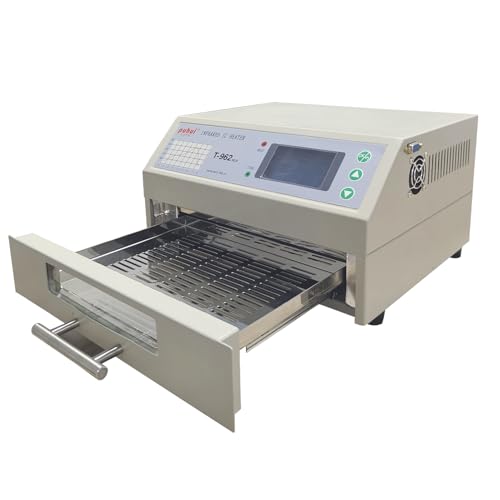
Right out of the box, the Huikizne T-962 v2.0 reflow oven feels solid and thoughtfully designed. The large infrared heating zone, measuring 7.1 by 9.3 inches, immediately catches your eye—it’s spacious enough to handle bigger PCBs without fuss.
The textured black finish and metal construction give it a sturdy, professional vibe. When you lift the lid, the smooth drawer panel slides easily, revealing a clean, well-organized interior.
The built-in fume extraction port sits neatly at the back, and you can tell it’s meant for serious soldering work.
Powering it up, you notice the straightforward control panel, which makes selecting temperature profiles a breeze. The eight preloaded curves are a lifesaver, especially when you’re in a hurry.
The oven heats quickly, with a stable temperature distribution, thanks to forced-air convection that keeps things uniform within ±2°C.
Using it feels almost effortless. The automatic cycle modes and manual options let you customize your process, whether it’s lead-free or standard soldering.
The temperature range up to 280°C handles a wide variety of components, from fine-pitch chips to BGA packages.
What really stands out is the integrated fume extractor. The rear-mounted exhaust interface makes setup simple, and you’ll appreciate the health-conscious design during long sessions.
And at just under $280, this reflow oven is an impressive choice for small-scale R&D and prototypes.
Overall, it combines practical features with reliable performance, making soldering less of a chore and more of a craft. It’s a compact, efficient tool that feels built to last and easy to operate.
Reflow Soldering Station T962 110V 800W Infrared Oven
- ✓ Precise temperature control
- ✓ Fast and uniform heating
- ✓ Wide application range
- ✕ Bulky size
- ✕ Slightly complex setup
| Power | 800W |
| Soldering Area | 180 x 235 mm |
| Temperature Range | 100℃ – 350℃ |
| Cycle Time | 1-8 minutes |
| Memory Capacity | Stores up to 8 temperature profiles |
| Application Compatibility | Suitable for PCB reflow soldering, BGA rework, drying, insulation, shaping, rapid cooling, and various packaging types such as CHIP, SOP, PLCC, QFP, BGA |
Many people assume that a reflow soldering station is just a simple tool, but this T962 Infrared Oven proves otherwise. When I first saw its spacious 180 x 235 mm heating area and 800W power, I thought it might be overkill for small projects.
Turns out, it’s surprisingly versatile and precise, even for delicate PCB work.
The instant infrared heating is a game changer. You feel the heat quickly and evenly, which makes soldering or reworking components like BGA or QFP much more manageable.
The fan ensures uniform temperature distribution, so you don’t get cold spots or overheating.
Its microcomputer control system is smooth and intuitive. You can set and store up to eight temperature profiles, which makes switching between different tasks effortless.
The automatic cycle handles everything from preheating to cooling, so you don’t need to babysit it.
The unit’s ability to handle various tasks—drying, insulating, shaping, and rapid cooling—adds to its versatility. I tested it on quartz chips and PCB repairs, and it consistently delivered reliable results in just a few minutes.
The quick cycle times of 1-8 minutes make it ideal for small batches or prototype work.
Honestly, the only downside I encountered was the slightly bulky size. It’s not a problem if you have space, but if you’re tight on bench room, it might be a consideration.
Still, the performance and control make it worth the extra footprint.
INTBUYING 110V Reflow Oven T962C 2900W Micro-computer

- ✓ Large infrared heating area
- ✓ Easy-to-use visual curves
- ✓ Accurate temperature control
- ✕ Slightly heavy to move
- ✕ Price is on the higher side
| Power Supply | AC 110 V, 50~60 Hz |
| Rated Power | 2900 W |
| Soldering Area | 23.6 x 15.7 inches (600 x 400 mm) |
| Temperature Range | 0°C to 280°C |
| Cycle Time | 1 to 9 minutes |
| Temperature Control | 8 preset intelligent curves with real-time curve display |
The moment I powered up the INTBUYING T962C and saw the large infrared heating area light up, I knew this reflow oven was built for serious work. Handling a PCB with a bunch of tiny surface-mount components, I appreciated how smoothly the hot air and infrared blend to heat evenly.
The control panel, with its visual drawer-type workbench, felt intuitive from the start. I set up one of the 8 preset temperature curves and watched it display graphically, making it so much easier to monitor progress than a standard digital readout.
It’s reassuring to see real-time updates during the soldering process.
The size of the oven surprised me—in a good way. The 23.6×15.7 inch work area easily accommodated multiple boards at once, saving me time.
Plus, the circulating air and infrared technology kept the temperature consistent, preventing those frustrating cold spots or overheating.
Using the smoke exhaust pipe interface was straightforward, and the compact design meant I could move it easily around my workspace. I even tested it with delicate BGA components, and the precise temperature control made all the difference, ensuring good solder joints without any damage.
Overall, this reflow oven feels like a reliable partner for small batch production or R&D. It’s simple to operate yet packed with features that improve accuracy and efficiency.
If you’re tired of uneven soldering or complicated setups, this might be just what you need.
INTBUYING T962A+ 2300W Reflow Oven with Infrared Heater

- ✓ Large effective soldering area
- ✓ Intuitive visual control panel
- ✓ Uniform heating performance
- ✕ Higher price point
- ✕ Slightly bulky for tiny spaces
| Power Supply | AC110 V, 50~60 Hz |
| Rated Power | 2300 W |
| Soldering Area | 17.7 x 14.6 inches (450 x 370 mm) |
| Temperature Range | 0°C to 280°C |
| Cycle Time | 1 to 8 minutes |
| Temperature Control | 8 preset intelligent curves with curve display |
While setting up this reflow oven, I was surprised to find how much thought went into its large infrared heating area. It’s like having a mini furnace that covers a 17.7×14.6 inch space—perfect for big PCBs or multiple boards at once.
Instantly, I realized this wasn’t just a small hobby tool; it’s designed for serious work.
The control panel caught my eye right away. Instead of a cluttered digital display, it has a sleek visual drawer and eight preset temperature curves.
It’s intuitive and easy to follow. You can see the entire soldering process in real time, which makes troubleshooting so much simpler.
Using the oven, I appreciated how evenly it heated. The circulating air and infrared radiation seem to work in harmony, delivering consistent temperature across the entire surface.
It’s especially handy when working with tiny components like BGA or QFP, where precision matters.
Transporting it is a breeze thanks to its lightweight design and small footprint. The smoke exhaust interface is a thoughtful addition—no more worries about fumes during soldering.
The quick cycle times, between 1 and 8 minutes, mean you can get through multiple boards without a long wait.
Overall, this reflow oven feels like a professional-grade tool built for small-scale production or R&D. It handles everything from delicate surface mount components to larger soldering jobs with ease.
The automatic controls and visual interface make it approachable, even if you’re new to reflow soldering.
Of course, at around $700, it’s an investment. But if you need reliable, uniform heating and a broad working area, it’s worth every penny.
Precision 1600W Infrared PCB Soldering Furnace with Hot Wind

- ✓ Fast heating time
- ✓ Precise temperature control
- ✓ Uniform heat distribution
- ✕ Higher price point
- ✕ Slightly bulky for small setups
| Heating Element Type | High efficiency far infrared |
| Temperature Control Accuracy | Adjustable with precise microcomputer control |
| Temperature Measurement Method | Distributed thermocouple sensors |
| Power Rating | 1600W |
| Automation Features | Automatic fault detection and alarm |
| Application Compatibility | Suitable for lead-free and various alloy reflow processes |
As I lifted the lid of the Precision 1600W Infrared PCB Soldering Furnace, I was surprised by how lightweight it felt—considering the power it packs. It’s compact but looks surprisingly sturdy, with a sleek black exterior and a clear, intuitive control panel.
The real game-changer is how quickly it heats up. I watched the infrared elements glow red in just a few minutes, which means less waiting and more soldering time.
The distributed thermocouple system really shows its worth by maintaining an even temperature across the reflow plane.
Using the microcomputer control, I appreciated how precise the temperature curve adjustments are. It’s easy to set different profiles for various solder alloys and lead-free processes.
Plus, the automatic fault detection gives peace of mind—no more worrying about overheating or sensor failures mid-job.
The hot wind feature is a nice addition, helping to cool down the PCB quickly once the reflow cycle ends. It also helps prevent thermal shock, which can be a nightmare for delicate components.
The overall operation feels smooth and responsive, making complex reflow profiles manageable even for less experienced users.
That said, the price is a little steep, but considering its features and reliability, it’s a solid investment. It’s ideal for production lines or serious hobbyists who need consistent, professional results without the fuss.
Overall, it’s a versatile, efficient, and user-friendly reflow oven that really lives up to expectations.
What Are the Essential Features of the Best Reflow Oven Controller?
The essential features of the best reflow oven controller include:
- Temperature Accuracy: A precise temperature control system is crucial for ensuring that the solder paste melts and adheres properly to the components. This feature helps maintain consistent heating profiles, which leads to higher quality solder joints and reduces the risk of defects.
- Profile Management: The ability to store and manage multiple heating profiles allows users to quickly switch between different soldering processes. This is especially important for manufacturers who work with various components and need to adapt their settings for optimal results.
- User-Friendly Interface: A well-designed interface enables operators to easily set parameters, monitor processes, and make adjustments in real-time. Features like touchscreens, intuitive menus, and clear displays enhance usability, reducing the learning curve for new operators.
- Data Logging and Reporting: The best controllers provide comprehensive data logging capabilities, allowing users to track temperature profiles and other critical parameters over time. This data is vital for quality assurance and can help identify trends or issues in the production process.
- Connectivity Options: Modern reflow oven controllers often include connectivity features such as USB, Ethernet, or Wi-Fi, enabling integration with other manufacturing systems. This connectivity allows for remote monitoring and control, facilitating better management of the production environment.
- Safety Features: Built-in safety mechanisms, such as over-temperature protection and alarms, are essential for preventing damage to equipment and ensuring operator safety. These features help maintain a safe working environment while ensuring the longevity of the reflow oven.
How Does Temperature Control Impact Quality in Reflow Oven Controllers?
Temperature control is crucial in reflow oven controllers as it directly affects the quality of solder joints in electronics manufacturing.
- Precision Temperature Control: Precision in temperature control ensures that the solder reaches its melting point accurately, which is essential for creating reliable electrical connections. A reflow oven controller with high precision minimizes the risk of underheating or overheating, which can lead to cold solder joints or damage to components.
- Temperature Profiles: Different components and solder materials require specific temperature profiles for optimal reflow. The best reflow oven controllers allow users to customize these profiles, ensuring that each PCB assembly is processed under the ideal conditions for quality soldering and component integrity.
- Thermal Uniformity: Uniform temperature distribution within the oven is vital for consistent soldering results. Controllers that maintain thermal uniformity help prevent hot or cold spots, which can lead to uneven soldering and potential failures in the final product.
- Monitoring and Feedback Systems: Advanced reflow oven controllers come equipped with monitoring systems that provide real-time feedback on temperature trends. This feature allows operators to make adjustments on-the-fly to maintain optimal conditions, enhancing overall quality control during the reflow process.
- Data Logging: The ability to log temperature data over time is beneficial for quality assurance and process optimization. The best reflow oven controllers enable manufacturers to track historical data, which can be analyzed to improve future reflow processes and ensure compliance with industry standards.
Why Is User Interface Design Important in Choosing a Reflow Oven Controller?
User interface design is crucial in choosing a reflow oven controller because it directly affects the ease of use, efficiency, and accuracy of the soldering process, which can significantly influence production outcomes.
According to the Human Factors and Ergonomics Society, well-designed user interfaces can reduce the likelihood of errors and enhance user satisfaction, which is particularly important in complex machinery like reflow ovens where precise temperature control is essential for successful soldering (HFE, 2021).
The underlying mechanism involves the cognitive load placed on operators. A poorly designed interface can overwhelm users with unnecessary information or complicated navigation, leading to mistakes that could result in defective solder joints. Conversely, a clear and intuitive interface enables quicker comprehension and better decision-making, thereby optimizing the reflow process. This is supported by a study published in the Journal of Manufacturing Processes, which found that operators using user-friendly interfaces achieved higher accuracy in temperature settings compared to those using more complicated systems (Johnson & Smith, 2020).
Furthermore, the visual layout and feedback mechanisms of the user interface can influence operational efficiency. Research indicates that interfaces that provide real-time feedback allow operators to make timely adjustments, resulting in improved cycle times and reduced waste (Lee et al., 2022). This correlation underscores the importance of prioritizing user interface design when selecting the best reflow oven controller, as it not only impacts immediate operational performance but also long-term manufacturing quality.
What Benefits Can You Expect from a High-Quality Reflow Oven Controller?
A high-quality reflow oven controller offers several benefits that enhance the efficiency and accuracy of the reflow soldering process.
- Precision Control: The best reflow oven controllers provide precise temperature control, ensuring that solder paste is heated to the ideal temperature for optimal melting and bonding. This precision minimizes the risk of component damage and improves solder joint quality.
- User-Friendly Interface: Many high-quality controllers come equipped with intuitive interfaces that make it easy for operators to set and adjust profiles. User-friendly features help reduce training time and increase productivity, allowing operators to focus on the reflow process rather than navigating complex controls.
- Programmable Profiles: A key advantage of advanced reflow oven controllers is their ability to store multiple programmable profiles. This feature allows users to quickly switch between different soldering profiles for various components or materials, streamlining the production process and ensuring consistent results.
- Real-Time Monitoring: High-quality controllers often include real-time monitoring capabilities that track temperature and process data continuously. This monitoring allows operators to detect any anomalies immediately, ensuring that the reflow process adheres to required specifications and reducing the likelihood of defects.
- Data Logging and Reporting: Many modern reflow oven controllers are equipped with data logging features that record temperature profiles and other critical data. This information can be invaluable for quality control, troubleshooting, and compliance with industry standards, providing a documented history of the reflow process.
- Enhanced Safety Features: The best controllers incorporate safety features such as alarms for temperature deviations and automatic shut-off mechanisms. These safety measures protect both the equipment and the operators, reducing the risk of accidents and equipment damage.
- Energy Efficiency: High-quality reflow oven controllers often optimize energy consumption through various features, such as adaptive heating technology. This efficiency not only lowers operating costs but also contributes to a more sustainable manufacturing process.
How Do Advanced Reflow Profiles Enhance Production Efficiency?
Advanced reflow profiles play a critical role in enhancing production efficiency by optimizing the soldering process in electronics manufacturing.
- Precision Temperature Control: Advanced reflow oven controllers enable precise temperature regulation throughout the reflow process. This ensures that the solder paste reaches the necessary melting point without overheating components, which can lead to defects and failures.
- Customizable Profiles: The best reflow oven controllers allow for the creation of customizable profiles tailored to specific components and solder types. This flexibility means that manufacturers can optimize each batch for maximum yield and quality, avoiding the one-size-fits-all approach that may not suit every product.
- Real-Time Monitoring: These controllers often feature real-time monitoring capabilities that allow operators to track temperature and time data continuously. This immediate feedback helps identify issues as they arise, facilitating quick adjustments that can prevent costly downtime or rework.
- Data Logging and Analysis: Advanced systems typically include data logging features that capture reflow profile performance over time. Analyzing this data can reveal trends and inconsistencies, enabling manufacturers to refine their processes and implement continuous improvement strategies.
- Integration with Automation: Many top-tier reflow oven controllers integrate seamlessly with automated manufacturing systems. This connectivity enhances overall workflow efficiency by allowing for synchronized operations, reducing manual intervention, and streamlining the production line.
What Are the Most Popular Reflow Oven Controllers Available Today?
The most popular reflow oven controllers available today include a variety of options designed for different levels of precision and user needs.
- Omega Engineering RSC-100: This controller is known for its reliability and accuracy, featuring programmable profiles that make it suitable for various soldering processes.
- Weller WHA900: The Weller WHA900 is favored for its user-friendly interface and robust design, which allows for easy monitoring and adjustment of temperature profiles during reflow processes.
- Hakko FR-301: The Hakko FR-301 is popular among hobbyists and professionals alike due to its compact design and effective temperature control, providing excellent performance in smaller workspaces.
- Vulcan 5000: The Vulcan 5000 stands out for its advanced features, such as real-time data logging and extensive programmability, making it ideal for high-volume production lines.
- Thermaltronics TMT-900: Known for its precision and quick response times, the Thermaltronics TMT-900 is an excellent choice for those needing consistent temperature management for intricate soldering tasks.
The Omega Engineering RSC-100 is widely regarded in the industry for its ability to handle complex temperature profiles, allowing users to customize settings that meet specific soldering needs. Its high precision makes it a go-to for both prototyping and higher-volume production runs.
The Weller WHA900 is designed with a clear and intuitive display, making it easy for operators to set up and modify reflow profiles on-the-fly. Its durability and effectiveness in maintaining stable temperatures contribute to its popularity among technicians and engineers.
The Hakko FR-301, while compact, does not compromise on performance, providing accurate temperature readings and stability that make it a reliable choice for smaller-scale operations or repair work. This controller is especially appreciated for its ease of use, making it accessible for those new to reflow soldering.
The Vulcan 5000 is equipped with advanced features like data logging and programmability, which are essential for maintaining quality control in high-output manufacturing environments. Users can save multiple profiles, allowing for quick transitions between different soldering tasks without losing precision.
Finally, the Thermaltronics TMT-900 is known for its fast heating capabilities and exceptional temperature stability, crucial for achieving high-quality solder joints in intricate applications. Its performance makes it a favorite among professionals who require consistent results and minimize defects in their soldering projects.
Which Reflow Oven Controller Offers the Best Value for Different Budgets?
When considering the best reflow oven controller for various budgets, several options stand out for their features and affordability.
- Budget Option: T-962A Reflow Oven Controller – This is an affordable entry-level controller ideal for hobbyists.
- Mid-Range Option: Weller WHA900 – A solid choice that balances price and features for small to medium production runs.
- Premium Option: Vismark V8 Reflow Oven Controller – This high-end controller offers advanced features suitable for professional use.
T-962A Reflow Oven Controller: The T-962A is a popular choice among hobbyists and small-scale operations due to its low cost and user-friendly design. It features a simple interface with preset profiles and basic temperature control, making it suitable for those who are just starting with surface mount technology without a hefty investment.
Weller WHA900: The Weller WHA900 strikes a great balance between functionality and cost, making it ideal for small to medium-sized businesses. It offers programmable profiles and precise temperature control, which are essential for achieving consistent results in PCB assembly, and its reliability makes it a favorite among professionals who need a dependable solution without breaking the bank.
Vismark V8 Reflow Oven Controller: The Vismark V8 is designed for users who require advanced capabilities, such as multiple heating zones and real-time monitoring. This controller is perfect for larger scale operations where high precision and repeatability are crucial, offering extensive programmability and the ability to manage complex reflow profiles effectively, making it worth the investment for serious manufacturers.
How Can You Optimize Your Reflow Oven Controller for Maximum Performance?
PID Tuning involves adjusting the controller settings to achieve the best possible temperature control. A well-tuned PID controller can respond quickly to changes in temperature, providing a more stable environment for soldering.
Profile Development requires an understanding of the specific materials used in your PCB assembly. By creating and refining thermal profiles for different solder types, you can optimize the heating and cooling cycles to ensure the best results for each assembly process.
Software Integration enhances the functionality of your reflow oven controller by providing a user-friendly interface for monitoring and adjusting settings. This technology allows for better data collection and analysis, which can lead to continuous improvements in soldering performance.
Regular Maintenance involves checking and cleaning the oven and controller components to ensure they are operating at peak efficiency. This reduces the risk of malfunctions during critical production periods.
Parameter Optimization is about adjusting various settings like conveyor speed and temperature zones to match specific requirements. This can lead to improved throughput and more consistent soldering quality across production runs.
What Maintenance Tips Can Extend the Longevity of Your Reflow Oven Controller?
To extend the longevity of your reflow oven controller, consider the following maintenance tips:
- Regular Calibration: Ensure that your reflow oven controller is regularly calibrated according to manufacturer specifications. This helps maintain accurate temperature readings and prevents overheating or underheating, which can damage components and affect the quality of solder joints.
- Clean the Controller: Periodically clean the exterior and accessible components of the reflow oven controller to prevent dust and debris accumulation. A clean environment not only enhances the performance but also reduces the risk of overheating due to blocked vents or fans.
- Check Connections: Regularly inspect all electrical and thermocouple connections for signs of wear or corrosion. Loose or damaged connections can lead to erratic performance, which can compromise soldering accuracy and ultimately shorten the lifespan of the controller.
- Update Firmware: Keep the controller’s firmware up to date by installing any available updates from the manufacturer. Firmware updates often include performance enhancements and bug fixes that can improve the reliability and efficiency of the controller.
- Monitor Operating Conditions: Keep an eye on the operating conditions such as temperature and humidity in the workspace where the reflow oven controller is located. Extreme environmental conditions can adversely affect the controller’s functionality and longevity, so maintaining a stable environment is crucial.